

Using plant species to combat wormer resistance
Internal parasites are a major challenge for livestock producers. In sheep production systems they can reduce growth rates and cause economic losses. Traditionally, anthelmintic drenches have been used to treat and control internal parasites, however the widespread development of anthelmintic resistance (AR) has increased the need for more sustainable parasite management strategies – such as the integration of bioactive forages into grazing swards.
What is a bioactive forage?
Bioactive forages are plants which contain natural compounds which can improve animal health as well as providing nutritional value. Bioactive forages are often included in swards referred to as herbal leys or multi species swards. Some examples of bioactive forages include the legumes sainfoin (onobrychis viciifolia) and birdsfoot trefoil (lotus corniculatus), and the non-legume chicory (chicorium intybus) which have all been found to reduce the negative effects of parasitism in sheep.
The bioactivity of plants is attributed to organic compounds which do not directly have a function in the primary metabolism of plants; i.e. affecting growth, reproduction or development. The compounds are instead known as plant secondary metabolites (PSM), such as condensed tannins (CTs), which have both direct and indirect anthelmintic effects.
Direct effects of CTs include damage to gastrointestinal worms. The compound binds to proteins on the worm which damages their structure and therefore interferes with their metabolic function- reducing the viability of the worm. The PSM can also prevent eggs from hatching or developing into larvae which reduces contamination of pastures. Studies have also concluded that by feeding bioactive forages the faecal-egg count (FEC) of a flock is significantly reduced.
CTs can also indirectly increase protein absorption within the digestive system of a ruminant due to the CTs reducing the microbial breakdown of protein in the rumen. This increases the proportion of bypass protein that passes to the abomasum, where it is digested and subsequently absorbed by the host animal.
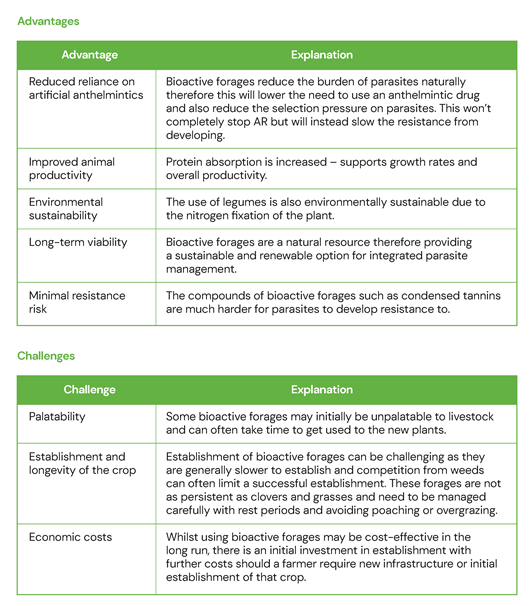
In addition to their antiparasitic properties, bioactive forages can also improve the energy and protein supply available to sheep. Chicory, for example, is drought tolerant and can provide valuable nutrition later in the grazing season when pasture worm burdens are often at their highest. Although chicory has a low dry matter content, it is commonly grown alongside grass, clover, or plantain. This combination of improved nutrition and reduced parasite challenge shows strong potential within sheep production systems.
Bioactive forages are not a complete replacement for wormers, but they could be integrated into a sustainable parasite management strategy. When used alongside good grazing management and targeted selective treatment, they could help reduce reliance on anthelmintic drenches whilst also supporting animal performance.
Katrina Coutts, Consultant, [email protected]
Posted by SAC Consulting on 16/06/2026
