

New breeding index offers route to lower flock emissions
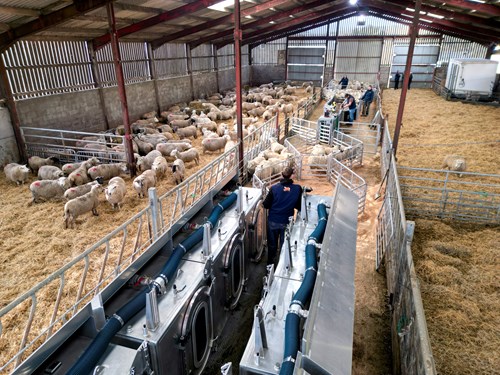
Reducing methane emissions and lowering the carbon footprint of sheep production while demonstrating environmental substantiality is becoming increasingly important for farmers and crofters.
For sheep farmers, the issue is not simply about responding to environmental pressure as in many cases, the same changes that reduce greenhouse gas emissions can also improve flock performance, reduce input costs, increase productivity, and strengthen the long-term profitability of the farm.
The Breed for CH4nge project set out (in a three-year initiative) to breed productive, efficient maternal sheep with a naturally low carbon footprint. This involved measuring methane output in fully-performance-recorded lambs to identify the best sheep to breed from, as well as data gathering on feed efficiency and rumen biology to develop a sustainable breeding strategy for ewes that make better use of our land and have a lower carbon footprint.
What did the project involve?
- 19,784 measurements of individual methane, carbon dioxide, and oxygen output on 13,581 sheep of seven maternal breeds across 40 flocks using a portable accumulation chamber (PAC) trailer.
- 8,241 faecal egg count (FEC) and 12,645 Immunoglobulin A (IgA) measurements to assess resistance to roundworms.
- Over 35,500 genotypes collected from fully performance recorded animals including all animals measured for methane and their relatives – used to develop genomic breeding values.
- Over 87,000 records of ewe weight and body condition score collected to improve the ability to select low methane animals that thrive in forage-based systems.
- Feed intake and feed efficiency recorded on 710 lambs fed on grass nuts in automated feed bunkers.
- 835 lambs with repeated methane measurements CT scanned and reticulo-rumen volume assessed.
- 1,146 samples of rumen fluid analysed from lambs with repeated methane measurements.
The project found that methane emissions are partly controlled by genetics, meaning breeders can now begin selecting animals with the potential to produce lower methane emissions without compromising productivity.
Data from 13,581 lambs measured across 40 flocks, along with flock data related to ewe efficiency, confirmed that methane production is heritable, resulting in the development of a new estimated breeding value (EBV) for methane output. This EBV feeds into the new Breed for CH4nge index that ranks animals on their breeding potential for a naturally low carbon footprint.
Methane produced during digestion accounts for around half of the carbon footprint of a typical sheep enterprise. With ewes responsible for the majority of flock emissions (ewes contribute approximately 66% of enteric and manure emissions, lambs approx. 32%) improving ewe efficiency remains one of the most effective ways of reducing emissions intensity.
Key findings
- The genetic improvement in ewe efficiency achieved over the last decade has reduced the methane intensity (methane per kilogram of carcase produced) by between 4-10% for the breeds involved in the project.
- Selection of breeding stock based on the Breed for CH4nge index could reduce methane/kg carcase produced by 20-30% over 10 years.
- There is a huge amount of variation between individual sheep in methane emissions.
- 30% difference in methane output between the highest and lowest emitters within a flock.
- 16% of this variation in methane output is attributable to differences in genetics.
- Most efficient 25% of lambs ate over 20% less feed (0.31kg DMI) per day, but grew at the same rate as least efficient 25% of lambs.
- Resistance to roundworms is highly heritable (approx. 40%) and not genetically related to methane output.
- A genetic relationship between lower methane (g/day) and smaller rumens.
- Differences in the abundance of rumen micro-organisms is related to differences in methane production.
- Most sheep farmers see improvements in efficiency as a way of reducing the impact of their flock on the environment.
What does this mean for farmers and crofters?
The new methane EBV and Breed for CH4nge Index results in tools to compare the breeding value of sheep in the flocks, identifying breeding stock that will contribute to improving farm carbon footprint.
While methane-reducing genetics alone will not solve the challenge of livestock emissions, they offer another tool that can be used alongside good flock management, health planning, and nutrition.
Dr Janet Roden, project leader from Innovis, summarised the project: “Sheep and cattle emissions are not always easy conversations because we often feel they are unfairly portrayed in the popular press. However, we believe this project has helped to identify the win-win solutions that can benefit both the farmer’s bottom line and the environment, consequently it offers them a sustainable route to improving their product’s environmental credentials while helping to address consumer concerns over the footprint of the meat they eat.”
Nicola Lambe, SRUC Research, [email protected]
Posted by SAC Consulting on 21/09/2026
