

Managing the transition onto autumn forage crops
Forage crops can play a significant role in extending the grazing season, reducing reliance on conserved feed, and providing livestock with a valuable source of energy. Crops such as forage rape, kale, turnips, swedes, and mixed-species forage can produce substantial amounts of feed but introducing them requires careful management.
A successful transition is not simply a matter of opening the gate and allowing stock onto a crop. Livestock need time to adapt to a different diet, while farmers need to manage intake, fibre, water, and grazing conditions.
Calculate stock requirement and crop availability
Calculating the daily feed allocation is an important part of transitioning livestock onto forage crops, allocation should be matched to the stock class and number of livestock being grazed whilst also allowing for realistic levels of crop utilisation and wastage. Getting the allocation right is important as it helps avoid overfeeding- resulting in wastage - as well as underfeeding – which could compromise animal performance.
Further information on calculating feed allocations for differing livestock classes can be found on the FAS website.
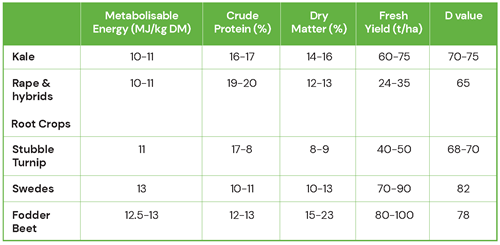
The table below highlights the nutritional value of forage crops.
Stock management
Before livestock are put onto a forage crop, it is important to ensure that all animals have been condition scored. Any stock above or below target condition should be managed separately.
Feet should be assessed before grazing forage crops. When grazing a long, narrow strip, the ground will become contaminated rapidly. If foot health of stock is already compromised the combination of wet and muddy conditions, along with grazing in close contact, will further increase the risk of foot problems spreading through the group. Remove and isolate lame animals and treat accordingly.
Belly clip young stock such as fattening lambs, prior to grazing on forage crops to prevent contamination and ensure that animals going to slaughter are clean.
It is recommended that forage crops are strip grazed using electric fencing to maximise the utilisation of the forage in situ and ensure that stock receive their daily feed allocation, with the fence moved daily or twice daily to ensure the crop being offered is fresh and palatable. Strips should be long and shallow to prevent wastage and trampling of the crop and benefit the shy feeding animals.
Regularly reassessing the crop and adjusting allocation as grazing progresses will help to ensure livestock are receiving a consistent supply of feed and that the crop is being utilised efficiently.
Why the transition matters
Forage crops can differ considerably from conventional grass pasture; therefore, it is important to transition stock onto forage crops gradually. A sudden change in diet can disrupt normal rumen function, particularly in cattle and sheep that have previously been eating mainly grass or conserved forage. Introducing the crop gradually gives the digestive system time to adapt and reduces the likelihood of problems associated with sudden dietary change e.g. acidosis and bloat. It can take around three weeks for the bugs in the rumen to adapt to a change in diet.
The nutritional value of forage crops also varies with crop type, maturity, and growing conditions. Understanding what the crop is providing is therefore an important part of the transition.
The length of the transition will depend on the livestock, crop, and previous diet. There is no single introduction period that is appropriate for every situation, so farmers should adjust the programme according to how stock respond.
Keep fibre in diet
Maintaining an adequate supply of effective fibre is a key part of managing forage crops. Animals should have access to an ad-lib supply of fibrous forage e.g. hay, silage, or straw alongside having a clean run-back area. A readily available source of fibre is vital for maintaining healthy rumen function, helping to support digestion, encouraging chewing and saliva production. The aim is to create a balanced diet rather than relying on the crop alone.
Forage such as hay, silage or straw should ideally be placed in the field in drier months to prevent soil damage from machinery when ground conditions are less favourable.
The run-back area provides livestock with an opportunity to forage on grass and provides a suitable surface for resting - rather than spending prolonged periods on the bare often muddy ground where the forage crop is being grazed – supporting animal welfare. If possible, a grassy headland within the field would make an ideal area for this.
Water and minerals
Fresh, clean drinking water should always be available. Although some forage crops contain substantial amounts of moisture, this should not be regarded as a substitute for drinking water. Attention should be made to trough location if animals are being strip grazed as poor water access could restrict intakes and therefore reduce animal performance.
Mineral requirements also need consideration. The mineral content of forage crops can vary, and deficiencies or imbalances may occur depending on the crop, soil, and wider diet.
Mineral supplementation should therefore be based on the needs of the animals and, where appropriate, forage or soil analysis and professional nutritional advice.
Where brassicas make up a significant proportion of the diet, iodine status should be considered, as the risk of goitre may be increased. Goitre is a condition which can affect animals grazing forage crops. The condition can develop as brassicas, and roots crops in particular, contain compounds which stop animals from absorbing iodine from their feed.
When coupled with the fact that brassicas are already low in iodine, this leaves animals with a considerable risk of being deficient in iodine. Iodine deficiency can interfere with hormone production, cause low growth rates, infertility, and stillbirths. To prevent animals becoming low in iodine, animals should be supplemented with extra iodine ahead of and during grazing brassicas.
Contingency plan - consider weather and ground conditions
Autumn and winter conditions can make crop grazing challenging at times. Allowing livestock to graze saturated ground can lead to poaching, soil compaction and damage to the crop and field. It is valuable to have a contingency plan, if weather prevents stock from grazing a forage crop as planned, knowing in advance what alternative feed and grazing options are available helps to manage providing an alternative feed.
A simple transition strategy
A practical approach is to:
- Assess the crop – establish what has been grown, its expected yield and its nutritional characteristics.
- Prepare the livestock – ensure animals are healthy and accustomed to the available supplementary forage.
- Avoid hunger – do not introduce stock to a large area of crop when they are excessively hungry.
- Start gradually – provide controlled access alongside their existing diet.
- Maintain fibre – continue supplying suitable grass, hay, silage, or other roughage where required.
- Control intake – use strip grazing or temporary fencing to manage daily allocations.
- Provide water and minerals – ensure these requirements are covered.
- Monitor animals – watch their condition, behaviour, and dung closely.
- Adjust the system – increase or reduce crop allocation according to livestock response and ground conditions.
Katrina Coutts, Agricultural Consultant, [email protected]
Posted by SAC Consulting on 21/09/2026
