

Managing your grass after first cut silage
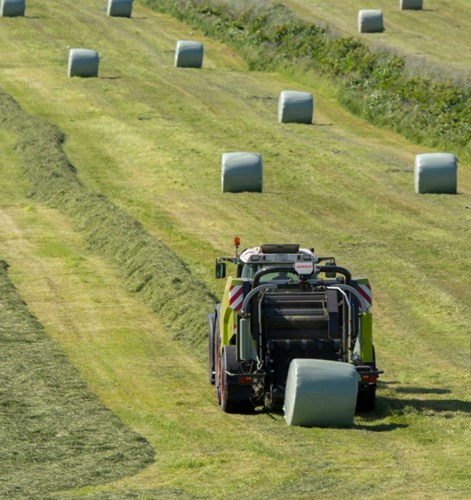
For many livestock farmers their silage crop is the most important crop they harvest. It’s therefore critical to manage the grass sward accordingly to ensure efficient and cost-effective production is maximised, while ensuring that silage quality and quantity is optimised
As the first cut of silage comes off fields, farmers are faced with the crucial question of what’s next? The actions you take after first cut silage have a significant impact on the quality of the next cut as well as the productivity and longevity of the sward.
Cutting date
Firstly, the cutting date needs to be considered, as second cut yields or regrowth can be limited if the first cut is delayed and the grass becomes too stemmy. Delayed cutting also reduces the energy and protein content of the silage, which can result in more concentrate feeds being required in winter to maintain liveweight gains.
Timing of fertiliser/slurry applications
Fertilising the aftermath with slurry or bagged fertiliser immediately after the first cut is critical as yields can be reduced by up to 6% if application is delayed by up to eight days. Delayed application of organic manure can also lead to higher levels of bacterial infection in the second cut which can affect the quality of the fermentation.
Slurry application method
The use of trailing shoes or dribble bars when applying slurry can also improve the efficiency of nitrogen use increasing grass yields by up to 25% through the minimisation of volatilisation and contamination of the sward, compared to splash plate application.
Fertiliser recommendations for second and third cuts
Silage removes significant quantities of nutrients, so it is important to replenish these losses to avoid poor regrowth.
Nitrogen Fertiliser
Application rates will vary depending on the quantity of silage required in subsequent crops but can typically be 90kg/ha of N for second cut and 70kg/ha for third cut. Clover dominant swards however can manage with significantly lower levels of nitrogen fertiliser.
Phosphate and Potash
Applications of phosphate in established grass/clover swards are generally aimed at maintaining soil phosphate levels at a moderate status (typically 12-20kg/ha of P2O5 for second cut and 10-15kg/ha for third cut). Higher applications can benefit clover-based swards if soil reserves are in a low or lower moderate status.
Potash is the second most important nutrient in silage crops, as offtakes can be considerable, resulting in the rapid depletion of soil reserves (especially on lighter soils) if not replaced with muck/slurry or a high potash fertiliser. It is therefore vital to ensure soil reserves are maintained at a moderate level. Typically, the level of potash required is approximately two thirds of the level of Nitrogen fertiliser, with any surplus applications applied at the end of the season to avoid luxury uptake and subsequent removal by the silage crop. Typical levels for second and third crop silage should be 50–60kg/ha and 40-50kg/ha.
Sulphur levels
As industrial deposition of sulphur decreases there is an increasing requirement to apply sulphur as a fertiliser and grass can be the second most responsive crop after brassicas. The most reliable prediction of the likely response to sulphur is to consider a herbage test ten days before your anticipated silage cut to determine if the Nitrogen to Sulphur ratio is greater than 13:1. Profitable responses to applications of sulphur can be obtained in second and third cuts of silage. Typical applications of 40kg/ha of SO3 are recommended.
Applications of organic manure however can enable significant savings in fertiliser as shown in the table below:
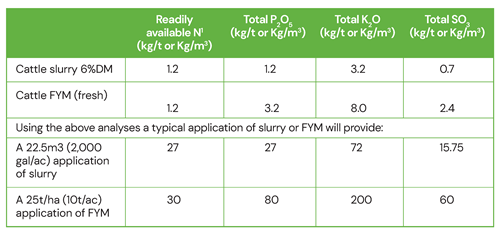
1 – Readily available N content is before losses of N due to leaching or gaseous emission.
Further information can be found at Scotland's Farm Advisory Service.
Long term aspects
Grass growth is influenced by temperature, moisture, soil pH, soil drainage, soil structure, and available nitrogen; therefore, it is also important to address the issues within your control, including drainage, soil pH and soil structure through appropriate long term investment in the field’s productivity.
Grass is still the cheapest feed source for ruminants, and investment in boosting growth and productivity are good investments, even with higher nitrogen fertiliser prices – e.g. 1 kg N at £1.45/kg (£500/t for 34.5%N) can provide approx. 15kg DM of grass (£0.09/kg DM or £90/tDM) compared to concentrate feed at £250/t.
Weed control
Cutting silage often leaves the ground bare in places, creating the perfect opportunity for weeds to germinate. Weeds to look out for and control include docks and thistles. It is important to tackle weeds early to avoid a reduction in grass yield. More information on controlling weeds in grass can be found at Scotland's Farm Advisory Service.
Reseeding
If you are faced with a tight turnaround time for reseeding silage fields and seek to control perennial weeds (e.g. docks, thistles and nettles) an application of glyphosate onto silage crops pre-cutting can also be done (at least five days prior to cutting). This method is perhaps less conventional but could be useful in island or hill locations where establishment times are critical due to the speed that autumn weather and colder growing conditions begin to limit grass growth, or where an autumn fodder crop seeks to be established.
Post-silage grassland management is a balancing act between short-term productivity and long-term sward health. Contact your local SAC consultant if you would like to discuss options whether you are planning to reseed, resting the grass, grazing after taking a cut or making a second cut of silage.
Ewan Johnston, Principal Consultant, [email protected]
Posted by SAC Consulting on 16/06/2026
