

Health planning – more than just a tick box exercise
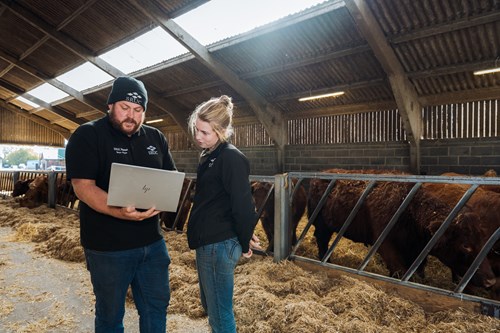
A health plan should be viewed beyond a tick box exercise for compliance with farm assurance schemes or the Whole Farm Plan (WFP) to being a tool to make more efficient use of resources – be that time or money – to increase productivity leading to greater profitability and enhanced sustainability of your herd and or flock.
Your team
Many of the animal health problems we face are interlinked with other aspects of the business from soil health through to finances. This means your agricultural consultant, nutritionist, and any other farm business or technical specialist can work together to benefit your business via the health plan, rather than working in isolation. However, integral to this is the relationship with your farm vet, they should no longer just be called for emergencies but viewed as an advisor.
Reflecting on previous successes (or failures)
As the year draws to a close, now can be a good time to sit down with your team to reflect on what has worked, or equally not worked so well, within your herd and flock to develop a plan to replicate (or not!) next year. We can all be guilty of favouring the good bits and blocking out the bad bits, so going through this process three to four times a year to coincide with key production cycle stages e.g. pre-lambing/calving, post-lambing/calving, weaning or bulling/tupping, keeps the memories fresh.
Setting future goals
Looking ahead to the next stage in our production cycle we can then set targets for what we want to achieve. These targets can be a mixture of technical and financial measures such as scanning percentages, growth rates (kg/day), or cost of finishing per kilo of liveweight gain. Remember “Rome wasn’t built in a day” so make these goals Specific, Measurable, Appropriate, Realistic, and Time-bound (SMART). Being too ambitious may be disheartening in the long run. What would you realistically like to achieve in your herd or flock in the next three months?
Remaining flexible
Inevitably there will be some hurdles on our path to success and preparing an action plan can mitigate some of the predictable risks and unexpected costs. Of course, we can’t plan for every eventuality and there are always new animal health challenges to contend with. Regularly reviewing our health plans means we can adapt and pivot as necessary or integrate any new developments. Done properly, health planning is truly dynamic.
The cycle continues
Before we can judge our success, we need to record some information to monitor our goals against. This does not need to be a demanding task – you only need to record the minimum level of information to know if your targets are met, and you may already have a lot of this data held in other farm records.
In farming there is often little time to dwell on mistakes as there are constant challenges and competing interests for resources. Each failure should be used as a learning opportunity to make a change, before starting the whole process all over again for the next production stage.
Tools to help you
If the minimum standards for WFP and farm assurance schemes are met, there is no right or wrong format for a health plan. Paper or digital versions are equally accepted. A range of templates such web apps including HerdPlan are available to help you.
Ultimately a health plan should never be consigned to a drawer to only see daylight when an inspector calls. To keep you motivated and on track to achieve your goals by avoiding missed tasks with costly consequences, regular reviews are important.
Five top tips
- Consider what you would like to achieve in your herd or flock over the next three months. For many this period will be the run up to lambing or calving.
- Set SMART goals. An example may be to have less than 5% intervention levels at lambing or spring calving 2027 due to dystocia by having all ewes and cows at a body score condition (BCS) 3.0.
- Develop a risk management plan. For the above example this may include body condition scoring six weeks in advance, completing forage analysis and getting a ration prepared, undertaking a mineral audit, and metabolic profiling three weeks before lambing or calving.
- Monitor progress. Have you completed all the tasks in your action plan?
- Review your plan, noting any reasons our targets have not been met or exceeded, and start the cycle all over again for the next production phase.
Laura Henderon, Senior Agricultural Consultant, [email protected]
Posted by SAC Consulting on 19/11/2026
