

Feed update - What’s driving prices this autumn?
With forage stocks tight in some areas and feed markets continuing to fluctuate, now is a good time to review winter feed requirements.
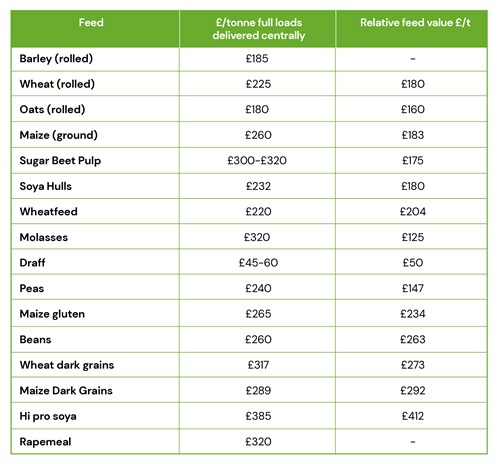
Feed prices are always changing and will depend on location, therefore please use these figures as a guide. The table below includes guide prices for feed delivered locally to Scotland’s central belt. The relative feed value (RFV) is shown to give an indication if a feed is considered a “good buy” compared to reference feeds barley and rapeseed meal, based on the energy and protein content, if the actual price is less than the RFV it’s considered good value.
Developments in the Black Sea are a key source of volatility for grain markets; the disruption is significant as Russia and Ukraine account for around 30% of global wheat exports.
As reflected in the price, feed wheat delivered is currently around £225/t with barley significantly discounted at around £185/t delivered. While barley quality has been an issue in England with significant quantities intended for malting being downgraded to feed, Scotland has generally been producing better yields and quality.
Oats have also been affected by the drought; therefore more oats are being pushed into feed markets. In terms of nutritional value wheat and barley are similar in energy and protein content, however, wheat is much higher in starch and less fibrous and breaks down much more rapidly in the rumen. Oats are typically considered a safer feed when incorporated into intensive rations, compared to wheat and barley due to a higher fibre content, however it is lower in energy and protein.
The European Union Deforestation Regulation (EUDR) is due to come into force from the 30 December 2026. The UK government is also set to introduce rules in Great Britain to tackle illegal deforestation in supply chains with a consultation expected later this year.
Dairy UK has also announced that milk processors will expect all feed to meet recognised deforestation free requirements from the 30 December 2026. The position applies to soy products which includes, soyabean meal, soya hulls, palm oil and palm kernel expeller.
This is likely to cause strain on the supply of sustainably sourced soya and its by-products with the effects already been seen in the European soya supply chain. In terms of distiller’s dark grains, the feed industry must source this outside of the UK therefore adding time and cost to the supply chain. This is reflected in the guide price, however maize dark grains are slightly better value at a guide price of £289/t.
In terms of relative feed value, soya is a good buy at £385/t and beans are also a good buy at £260/t but be careful when included beans in a high cereal ration due to the starch content.
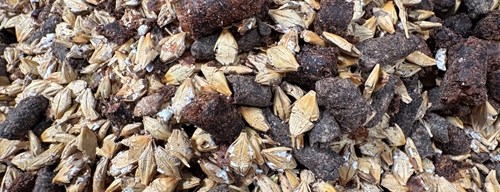
Sugar beet pulp is a good source of digestible fibre for ruminants; however, it is in short supply, hence the high quote of £300-320/t. The UK sugar beet season started late due to the dry weather and volumes are down. Soya hulls are another good source of fibre that would be a suitable alternative if sugar beet pulp can’t be sourced. Similarly, draff is also limited in many areas, but anecdotally quotes have been around the £45-60/t mark, if you can get it.
With forage stocks tight in some areas making a feed plan is as important as ever, it’s vital that farmers sit down with their feed adviser and look at their feed budget for the winter ahead, to try and mitigate as much as possible the exposure to feed price volatility and feed availability.
Mary Young, Ruminant Nutritionist, [email protected]
Posted by SAC Consulting on 19/10/2026
