

Balancing worm control and resistance in sheep flocks

As we turn the corner from spring to summer, worm burdens become an increasing concern for sheep farmers across the country. Also, climate change is changing the epidemiology of worms meaning we can’t rely on calendar-based treatments.
A sustainable parasite and worm control plan should be part of the farm health plan designed alongside the farm practice vet. Internal parasites are a challenge to flock health, welfare and productivity. While wormer products (drenches and injections) remain an essential tool for parasite control, many farmers are finding that these treatments are no longer as effective as they once were.
Why is this happening? The answer lies in Anthelmintic (wormer products) Resistance (AR). As resistance increases, managing parasite burdens becomes more difficult, making AR an increasingly important issue for sheep farmers.
What does resistance mean?
Worms that are not killed by the correct dose of wormer product.
Resistance has been further accelerated by factors such as over-reliance on a single wormer class, underdosing due to inaccurate weight estimates and routine blanket dosing. AR can be slow to develop and once established is very hard or impossible to reverse.
Why worry about resistance?
AR is a major concern because it can reduce flock productivity and increase costs for farmers. When wormers stop working properly, sheep may continue to carry high worm burdens, which can lead to poor growth rates, weight loss, diarrhoea, lower body condition, and reduced overall performance.
Lambs may take longer to reach market weight, while breeding sheep may have poorer fertility and reduced milk production. In severe cases, high parasite burdens can cause illness or death.
These productivity losses can have financial implications also, as farmers may face lower profits due to slower growth and lighter animals being sold, alongside increased spending on appropriate treatments. If AR becomes widespread, fewer effective wormers remain available which makes parasite control more difficult and expensive in the future. Therefore, sustainable worm control plans are essential to protect both animal health and business profitability.
How to slow the development of resistance?
A parasite control plan should be specific to your farm – please speak to your vet.
Correct use of products
It is important to use the right product at the right time at the correct dosage rate, making sure dosing equipment is checked/calibrated. The focus should be on the correct selection of wormer. Careful use and rotation of wormer classes can help slow the development of AR within a flock. Repeated use of the same drench group places selection pressure on the worm population, increasing the likelihood that resistant worms survive and reproduce.
The three older broad-spectrum wormers – white, yellow and clear - have been used widely for years with more resistance developing to these classes. Newer classes are available (orange and purple) with significantly lower levels of resistance reported.
Currently there are no recorded resistance to purple (group 5) yet in UK.
Only treat when needed - Faecal Egg Counts (FEC)
FEC testing is becoming more important in modern worm control management. FECs allow farmers and vets to assess the parasite burden on their sheep before deciding whether treatment is necessary – they also can help evaluate whether wormers are still working effectively on farm.
FECs work by counting the number of worm eggs in faeces – the results are presented as eggs per gram (epg) of the dung with the epg providing an indication of the number of adult worms in the gut of the sheep. However, there are some limitations to be mindful of including different species affecting interpretation of results and faecal consistency can make a difference.
To undertake a FEC, most local vets offer testing, or you can use commercial testing kits – such as FECPAK - or undertake a DIY approach!
For advice on how to collect a good quality faecal sample, watch The Moredun Group's video.
Instead of relying on an assumption about worm burdens FEC testing can provide evidence-based information to aid worm control decision making.
1. Dosing strategies
When controlling worms in sheep, it is important not to treat every animal in the flock. Treating all sheep with wormers too often can lead to worms becoming resistant to treatment, meaning wormers may stop working overtime. Instead, farmers aim to maintain refugia, which is the group of worms that have not been exposed to wormers. Ideally, around 10% of animals are left untreated. These untreated worms remain sensitive to wormers and breed with any resistant worms that survive treatment, helping to reduce resistant genes in the worm population and slow down AR in the flock.
One way to do this is through Targeted Selective Treatment (TST). TST means only treating sheep that are struggling to cope with worms, while leaving healthier animals untreated. Sheep should not be chosen at random, as this can reduce the benefits of refugia.
Instead, farmers should use signs or markers to decide which animals need treatment. These include visible diarrhoea, faecal egg counts (FECs), body condition score, liveweight gain, and overall performance. TST can help reduce medicine costs and save labour by avoiding unnecessary treatments, but it does require farmers to be confident in checking sheep health and recognising which animals need help.
2. Grazing strategies
Worm control isn’t solely about making sure you use the right drench; grazing management also plays a major role in reducing parasitic pressures. The risk levels for pastures with various grazing histories table on scops.org.uk highlights the importance of focusing on pasture risk assessment (high/medium/low) depending on grazing history and stock class.
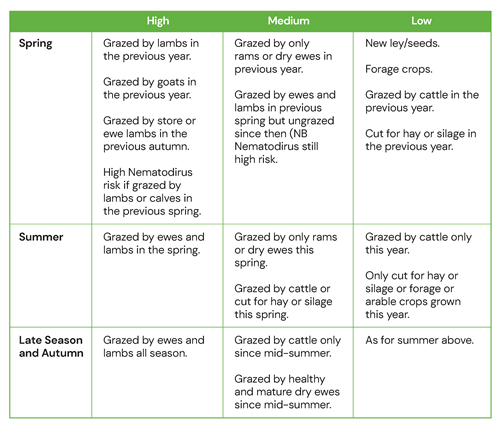
Table 1. Risk levels for pastures with various grazing histories
3. Quarantine protocol
Quarantine protocols play an important role in parasite control by reducing the risk of bringing resistance worms into the flock. New sheep or animals returning from grazing elsewhere may carry parasites that are resistant to wormers. If these sheep join the flock immediately, resistant worms can spread and make parasite control more difficult. To prevent this, new animals should be kept separate from the flock and treated before mixing.
Further information on quarantine treatments and procedures can be found on scops.org.uk.
How do you know if you have resistance?
Wormer resistance may be present if sheep continue to show signs of worms after treatment or if wormers no longer seem to work effectively. The best way to check for resistance is to do a FEC reduction test. This involves taking a FEC sample from animals before treatment and testing the exact same animals again after dosing to check whether worm egg numbers have reduced. If egg counts stay high, it may indicate resistance to the wormer.
Protecting the future:
There is no single solution to AR. Sustainable worm control requires a combined approach involving monitoring, targeted treatment and good grazing management. It is no longer as simple as killing all worms in the gut of the sheep, it is about protecting animal performance whilst also ensuring treatments can remain effective and available for years to come.
5 top tips
- Worm control is a vital part of flock health planning. Alongside your farm vet, ensure that a sustainable worm control plan is included as part of the flock’s annual health plan.
- Ensure that any anthelmintic treatment given is fully effective. Calibrate equipment, ensure that medicine has been correctly stored and is correctly administered.
- Aim to reduce reliance on anthelmintics through management practices and pasture risk management e.g. rotational grazing and grazing alongside cattle.
- A faecal egg count can be used to help determine the need to treat, test the effectiveness of a treatment and provide information on pasture contamination.
- Ensure a robust quarantine protocol is in place to reduce the risk of bringing resistant worms and other parasites on to the farm.
Katrina Coutts, Consultant, [email protected]
Posted by SAC Consulting on 16/06/2026
