

Selecting prime lambs for market
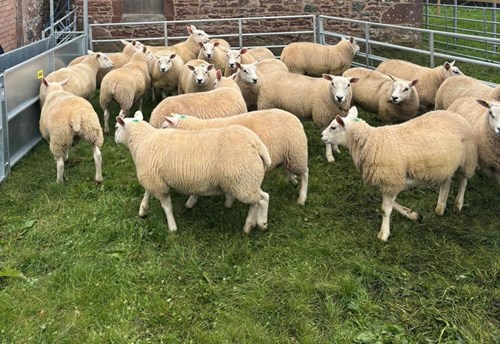
It is important to know when your lambs are ready for sale so that you can maximise returns from your flock. With many of the earlier lambing flocks now considering their first draw, it is essential to ensure lambs are the correct specification to get the best returns as new season lambs start coming through the live ring. Here is a reminder of some of the key things to consider when selecting finished lambs for market.
Weight – Regularly weighing lambs and splitting them into groups based on their weight can help you predict when your lambs will be ready for sale as well as avoiding overfat lambs. Aim for lambs to be in a liveweight range of 42kg to 48kg which will then roughly equate to a deadweight of 16kg to 22kg. Heavy lambs which are over 48kg tend to be best sold through the live ring, to avoid payment caps. Lambs should be weighed empty, to exclude belly-fill as a factor affecting weights.
Fat cover – Alongside the weight of the lamb it’s important to access the fat cover. A lamb may weigh 45kg but may not be well fleshed. The three main areas to feel to gauge if the lamb is carrying the correct amount of fat are the loin, ribs and dock/tail. When feeling the loin area, the lamb is not finished if you can feel the spinous processes prominently when putting a hand over the back of the lambs. If the ribs feel like they only have a little fat cover, it is likely the lamb is not fat enough for slaughter and likewise if the tail bone can be felt easily then it is not sufficient fat cover for slaughter.
Presentation – Once the lambs have been selected based on fat cover and weight it is important to visually access the lambs looking for signs of lameness and ill health. Ensure that lambs are clean before marketing. Presentation of lambs will help to maximise returns.
It is important to consider the market in which lambs are destined for, each market has different requirements and farmers should target those that are looking for the type of lamb they can produce consistently. It may be tempting to produce a batch of lambs and then try to find a market for them, when it is better to identify the potential market and or customer and then produce the type of lamb that they are looking for that suits their needs. When drawing and selecting lambs it is important to identify the different requirements and send the lambs to the desired end user. The supermarkets tend to want a consistent product which will fit their standard packaging, so they'll be looking for the mid-range of carcass weights which offer greater uniformity. Butchers would tend to go a little bit heavier and lambs for exporting tend to be a bit lighter.
When to sell fat lambs
Like most products sold off the farm, timing can be key to realising the best price possible for the product. The first notable spike in prices for lambs is usually in mid-May; this is when the first new season lambs start to come available through markets and slaughterhouses. Early lambing January flocks are aiming to hit this peak in the market.
As prices fluctuate throughout the season, it is important to plan ahead. Target an ideal time for selling, based on expected feed, labour availability and market prices. If considering selling prime lambs in the coming weeks it is advisable to talk to auctioneers and buyers to decide the optimum time to market your lambs.
Jamie Houstoun Agricultural Consultant, [email protected]
Posted by SAC Consulting on 18/05/2026
