

Why grazing management is critical for spring performance
As the grazing season draws to a close, one of the most important decisions livestock farmers can make is knowing when and which fields to shut off to allow grassland to recover ahead of spring. Grass growth has significantly reduced over the last month as daylight hours shorten and temperatures drop. Now is the time to plan ahead to ensure grass availability, sward quality and grazing performance in the following year.
Taking stock off pasture at the right time, in late autumn/early winter can have a significant influence on grass availability in the following spring. While most of you will try to utilise every last bit of grass, continuing to graze too late can compromise grass growth as well as damage soil structures and reduce the productivity of pastures next spring.
Although grass growth is affected by many factors such as cold spells, drought or waterlogging, the grass growth pattern for Scotland remains fairly consistent.
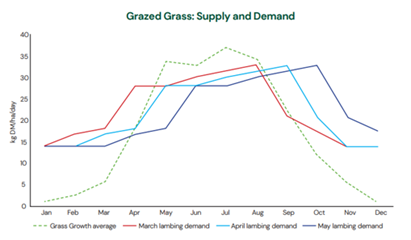
Source: Forage First Sheep Systems (SAC Consulting)
The table above shows the grass growth average; it is clear to see that grass growth decreases rapidly from early October onwards and not lifting significantly again before late March. While sheep farmers attention is on the best quality grazing platforms over the ‘golden 20 days’ of tupping, it is important to think ahead to winter grazing and consider early spring grazing platforms.
Fields destined for early lactation/turn out grazing should be grazed first, this not only utilises the platform but resets it for a rest over the winter before grazing when growth is still limited. A study carried out by the West of Scotland Agricultural College showed that grazing platforms continuously grazed in the period between January and March led to grass yield reductions in April by up to 40%. With this in mind, the paddocks to be grazed in early spring should be grazed and stock removed by December, to protect grass over the winter and ensure a reliable supply of grazing for the following spring
To get the most from winter grazing, utilisation of the grazing platforms is essential. One way in which to best utilise winter grass is to rotationally graze the flock. By grouping up ewes and grazing as a mob the grass will be grazed evenly, ewes set stocked will selectively graze leaving an uneven residual platform, this not only underutilises the grass but also leaves wastage into the next grazing year. This improved utilisation will not only leave a tight, even platform but will allow for longer rest periods, giving the pasture the best chance for optimal spring growth. With careful planning, this rotational grazing can stretch the winter allocations, delaying the feeding of supplementary forage until later into the winter.
Avoid grazing fields when soil conditions become unsuitable. As rainfall increases and temperatures drop, soils become increasingly vulnerable to poaching. Also, livestock travelling across wet ground can damage the soil surface. This damage then has consequences beyond the winter months. Remove stock from fields before significant poaching and avoid grazing fields more vulnerable to poaching.
While the suggestion of allowing long rest periods on grazing platforms is useful, many systems simply cannot afford to do this. The aim is to achieve a balance between sufficient winter cover and maintaining good quality grass for the next season. Grass supply is tight over the winter and the thought of shutting off fields is simply not feasible for some. To keep stock off the spring grazing platforms some other methods can be considered.
The grazing of winter cereals is having a resurgence, commonly carried out on many mixed farming systems in the 1970s and 1980s the method is becoming more popular again. Milder autumns, and earlier harvests mean winter cereals are increasingly more mature as we enter the winter months. By grazing these cereals back, it can help promote tillering, reduce fungicide usage and check crops to reduce any potential winter damage. It is important to only consider this grazing option if the crop is between growth stage 21-29 and the plants are well rooted; it is also important to avoid grazing stressed crops.
The best way to utilise winter cereal grazing is to stock the field heavily and graze for 3-14 days, ensure that field conditions are suitable to avoid damaging the crop. The high stocking density will encourage even grazing and allow the grazing to be carried out quickly.
The changes in greening rules mean that farmers are increasingly encouraged to not leave fields bare over the winter. Many producers have started putting cover crops in to help meet these rules, this provides a potential opportunity for graziers to utilise these covers and give an increased chance of resting grazing platforms for optimal spring growth.
Five top tips
- A planned approach to closing off grazing fields now, will help to ensure there is a good grass supply in the spring.
- Identify now which fields will be needed for early spring grazing. These should be prioritised for closing off, allowing sufficient time for recovery and grass growth before spring grazing begins.
- Aim for a rest period of 90-120 days for optimum early spring grazing.
- Monitor conditions throughout winter ensuring that fields do not become over poached.
- Consider other grazing options besides grass for winter including grazing winter cereals or cover crops.
Useful links
Jamie Houstoun, Consultant, [email protected]
Posted by SAC Consulting on 19/11/2026
