

Using FerAppease to Reduce Stress Losses in Beef Cattle
Stressed cattle are a well recognised challenge in beef breeding and finishing enterprises, reducing productivity and compromising animal health. Stress is also closely associated with key diseases, particularly pneumonia, making its reduction and management a key priority for farmers.
FerAppease is a new pheromone-based spot-on available through farm vets, which can reduce the impact of stress on livestock health and production. Working alongside a group of Northeast farmers, we have been exploring how FerAppease can best be used on Scottish suckler and finishing units on potentially stressful situations by means of several small independent farm trials.
In each trial, we were interested in common management procedures that might lead to production loss due to livestock stress including weaning, the arrival of store claves purchased from the west coast and immediately prior to transport to slaughter. The trials involved animal behavior being closely observed by farmers to monitor health and performance outcomes.
- Weaning - Weaning stress on a breeding unit might reduce growth rate by 300g/day for 60 days, a cost of ~£81/hd. 94 cattle in study total.
- Store calf sales - Stress associated with sale, transport and mixing might reduce growth rate by 400g/day for 60 days, a cost of ~£108/hd. 236 animals in study total.
- Transport to slaughter - Transport stress might reduce KillOut% of fat cattle by up to 2%, at a cost of ~£85/hd. 108 cattle in study total.
On each farm, FerAppease was applied to approximately half of the animals that were under observation. We took care to ensure that all other management practices were the same, so that we could compare the outcomes of animals that had FerAppease and those that didn’t.
The results are summarised in the table below. There was a significant difference in performance in store calves that were treated with FerAppease at the mart immediately after purchase before transport home. In this situation the calves that received FerAppease had a much lower check-in growth rate, leaving a clear cost-benefit.
In the transport to slaughter trial, there was also a trend indicating a cost benefit due to FerAppease, though the difference was not statistically significant.
Interestingly, in the weaning trial neither the treated calves nor the control group had any growth rate check in the 60 days after weaning, and so there was no difference between the groups. In store calves treated at first handling on the finisher farm (so after the stress of transport, sale and mixing had passed) there was a similar growth rate loss in both treated and control groups.
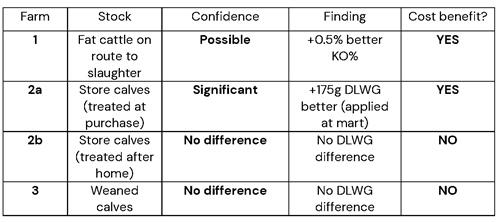
These trials provide further evidence that FerAppease can offset production losses associated with management stress, in the right situation. In cases where the product is applied before a significant stress, a reduced check in growth rate can be achieved. If the product is applied too late (e.g. after store calves are already home) or where the stress is mild (e.g. if the management change doesn’t cause any production loss) then a measurable difference is less likely. The results are consistent with a recent scientific review of 18 international trials. The review found that blood cortisol, the stress hormone, is consistently and significantly reduced by using FerAppease, but that does not always lead to a measurable production difference.
For anyone interested in finding out more about FerAppease and whether it could help in your own system, discuss with your farm vet for best advice.
Tim Geraghty, Vet Consultant, Dunnydeer Veterinary Group
Posted by SAC Consulting on 17/04/2026
