

What’s Changing in Agricultural Wages
On 1 April 2026, the most recent update to the Agricultural Wages (Scotland) Order came into force. This article will summarise the key changes to be aware of as well as offering a reminder of the key features of The Agricultural Wages (Scotland) Order (No.73). It is vital that farming businesses ensure the pay rates and other policies they have in place are in line with the order.
The main changes include:
- An increase to the minimum hourly rate and the dog allowance.
- The daily rate for accommodation other than a house provided by the employer has also increased.
- An increase to the additional sum payable to workers with appropriate qualifications
The minimum hourly rates of pay from 1 April 2026 are shown below. The increase to the minimum hourly rate equates to a 4.1% increase on the previous year.
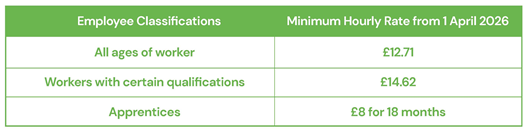
The minimum rate of pay for overtime is 1.5 times the minimum hourly rate that that employee is entitled to. Therefore, for a worker without qualifications, the minimum hourly rate for overtime would be £19.07/hour.
Workers who hold a qualification in agriculture or production horticulture at Level 3 (SCQF 6/7) or above, and where it is relevant to the work being carried out, are entitled to a £1.91/hour top up to the minimum hourly rate. SCQF 6 qualifications include Modern Apprenticeship Certificates and National Certificates (NC) while a Higher National Certificate (HNC) classes as a SCQF 7. Therefore, these qualifications and others above such as diplomas or degrees all entitle employees to the higher rate of pay.
The dog allowance has increased to £11.18/week/dog for up to four dogs. It is mandatory to make this payment if a worker needs to keep and feed a dog (or dogs) to effectively do their job. This amount is non-taxable.
From 1 April 2026, any deduction an employer makes from a wage in respect of accommodation other than a house shall not exceed £10.66/day. Accommodation that would qualify would be caravans or static homes, but the deduction must only be made for each day in the week that living accommodation is provided.
Businesses have the voluntary option to pay employees in equal instalments for each pay period regardless of the number of hours worked. This is known as a Stable Income Arrangement (SIA).
For employees who work varying number of hours across the seasons, the SIA will mean they benefit from a regular amount of pay each period while it will offer regular outgoings for employers making budgeting easier.
Overtime in these arrangements is not paid as you go along throughout the year as it may be in hourly paid situations. However, come the end of the financial year, you would need to collate all the employee’s timesheets for the year and calculate what they would have been due for those hours if they had been paid hourly as per the order.
If the salary received matches or is greater than the amount calculated, then you are doing everything you need to. However, if the payments made via the SIA equate to less than what the employee would have received had they been paid by the hour then you would be required to pay them a lump sum at the end of the financial year for the shortfall.
Holiday entitlement is calculated based on the number of days the employee works and the table summarising this can be found in the employers and workers guide linked at the bottom of this article. In addition to the number of days stated in the table, all workers are entitled to two special days of leave per year: Christmas Day and New Years Day.
Timesheets are required within agricultural businesses. A monthly or weekly template is available online from the Wages Board. Once complete, the employee should return these to the employer who then has a duty to retain them for at least three years.
The responsibilities of the employer do include ensuring that workers are provided with the weather protective clothing that they need to be able to do their job and also that this clothing is repaired or replaced when no longer fit for use.
For anybody who is employing somebody new, a reminder that they should be provided with a written statement of terms and conditions on or before their first day of work. There are exceptions for terms relating to pensions, training entitlement and disciplinary and grievance procedures which must be given no later than two months after their employment started.
5 top tips
- Check that the pay of all employees is meeting the new minimum hourly rate as of 1 April 2026.
- Check the level of qualifications workers have and if necessary, ensure you pay the top-up rate. If you are unsure what SCQF level a qualification is, type the qualification followed by ‘SQA’ into a search engine and this information should be accessible.
- Consider whether moving employees onto a Stable Income Arrangement would be of benefit to your business.
- Consult the Agricultural Wages in Scotland Guide for Workers and Employers for more info on Stable Income Arrangements and holiday entitlement or contact your local SAC Consulting office to discuss.
- Ensure timesheets are being completed and retained.
Mhairi Dalgliesh, Agricultural Consultant, [email protected]
Posted by SAC Consulting on 16/04/2026
