

Why feed analysis pays dividends
Feed is one of the biggest costs on livestock farms. Therefore, knowing the actual nutritional value of home-grown feed should be the starting point when planning feed rations.
A clamp may be full of silage and the shed stocked with barley, but how much energy and protein do these feeds contain? Before deciding what additional feed to buy, analyse what you have got.
Start with forage
Forage analysis provides the foundation to formulating a well-balanced ration. Forage can vary considerably in dry matter, energy, protein, digestibility, and fibre content. Appearance alone cannot tell you what level of livestock performance it will support.
Knowing the analysis ensures forage can be matched to the animals that it is best suited to. Better quality forage can be targeted towards finishing cattle, growing stock, cows in early lactation, or ewes approaching lambing. Poorer forage can therefore be allocated to animals with lower nutritional requirements.
Crucially, analysis also tells you what needs to be added. For example, if silage is high in metabolisable energy (ME) or crude protein (CP), little to no additional feed may be required (depending on animal requirements). If it is poorer than assumed, identifying the shortfall allows the ration to be corrected before growth rates, body condition or other aspects of livestock performance suffer.
The aim is not simply to feed less concentrate. It is to use the forage you have as effectively as possible and only purchase the feeds required to fill the gap.
Analyse your barley
The same principle applies to home-grown cereals and is particularly relevant where barley quality is variable. Dry growing conditions can affect grain quality, resulting in higher screenings and variation in nitrogen levels. With more barley potentially available for livestock feeding, it can provide an attractive energy source. However, it is vital that you do not assume that all barley has the same feed value - analyse it.
Checking barley nitrogen allows its crude protein content to be calculated, and relatively minor differences in nitrogen can have a surprisingly large effect on the amount of supplementary protein required. To convert barley nitrogen content into crude protein content, on a dry matter basis, multiply the grain nitrogen percentage by 6.25.
For example:
- 1.4% nitrogen = 8.75% crude protein,
- 1.8% nitrogen = 11.25% crude protein
In a ration for a 600kg intensive finishing bull, barley at the lower nitrogen level could require supplementation of an extra 0.9kg/head/day of rapemeal, compared with the higher nitrogen barley, to supply sufficient protein for the same level of performance. Across a shed of finishing cattle and throughout an entire feeding period, that difference can add up to a considerable quantity of purchased protein, as shown in the example below:
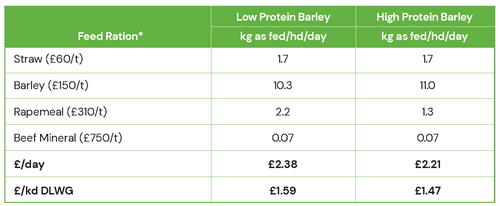
* Based on a 600kg, medium maturing bull, aiming for 1.5 kg DLWG
Knowing the protein content of the barley, particularly if barley makes up a significant part of the ration, allows you to correctly balance what additional protein is needed to avoid over or under supply. Increasing efficiency and potentially reducing feed costs.
Know the dry matter and the weight
Nitrogen (protein) is not the only useful figure from barley analysis. Dry matter also affects the quantity of fresh grain required to supply a given amount of nutrients and should be considered when the ration is formulated.
Specific weight is another practical consideration where grain quality is variable. Lighter barley occupies more volume for a given weight, meaning the scoop, bucket or bag traditionally used for feeding may contain fewer kilos than expected. Bruising or rolling grain can exaggerate this because processed grain is less dense than whole grain.
If feeding by volume, weigh the scoop, bucket, or bag periodically rather than assuming what it contains. Small inaccuracies each day can become significant across a group of livestock over several months.
Analyse first, formulate second
Barley remains a high-starch feed and is not a balanced ration on its own. Depending on the barley analysis and livestock requirements, additional protein will usually be required alongside appropriate fibre, minerals, and vitamin supplementation.
Good examples of high protein feeds are rapemeal, soya and dark grains. Or it could be a blend or compound feed. But the important question is not simply which protein source to buy, it is how much protein needs to be bought. That calculation should start with analysis of the feeds already on farm. Formulating rations around the actual results rather than assumed or standard book values.
Feed analysis is therefore more than a nutritional tool; it is a financial one. Before asking, ‘What feed do I need to buy?’, ask a more important question – ‘What have I already got?’.
Know the energy and protein in your forage. Know the protein and dry matter of your grain. Then purchase only what is required to balance the ration and achieve the desired livestock performance.
Samantha Stewart, Consultant, Samantha.Stewart@sac.co.uk
Posted by SAC Consulting on 21/09/2026
