

Choosing the best establishment method for EFA green cover
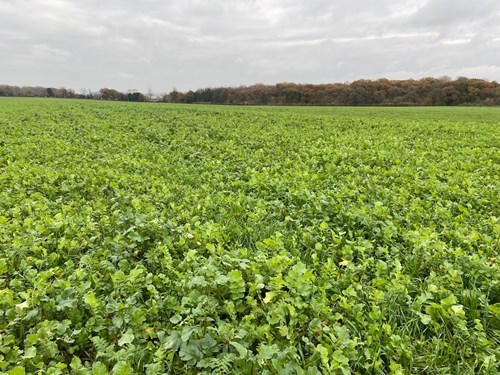
This year, many mixed farms will be introducing Ecological Focus Areas (EFAs) for the first time. EFA green cover (EFAGC) is one of 11 Ecological Focus Area (EFA) options available. Green cover is the establishment of a temporary crop in the autumn, enhancing biodiversity and improving soil structure and fertility, as well as preventing soil erosion and nutrient leaching. It can be grazed however sufficient vegetation must remain to maintain continuous ground cover until 31 December.
EFA Green Cover requires to be established by 1 November and maintained until 31 December. You must establish a green cover consisting of two or more of the following crops, alfalfa, barley, alsike clover, balansa clover, crimson clover, red clover, persian clover, white clover, buckwheat (can cause skin Photosensitisation), mustard, oats, phacelia, radish, rye, triticale, vetch, kale, forage rape, stubble turnip, beans.
Earliness of sowing is key, giving the crop longer to establish and grow before winter. An additional week can make a noticeable difference to establishment and biomass production during the autumn. If you are later than the first week in September, ensure your predominant species is a large seed which has the supply of energy to get the plant well established. With a relatively short establishment window, particularly following spring crops, choosing the right establishment method is important to producing a successful green cover.
The three most common establishment methods are broadcasting, direct drilling and conventional cultivation. Cover crops can be broadcast into standing crops, prior to harvest. Seed can also be broadcast after harvest using a quad bike-mounted spinner before the straw is baled. Establishing the crop at these earlier stages gives it more time to germinate and grow before winter, while also helping to spread the workload during a busy harvest period. However, soil moisture is a limiting factor, as successful establishment relies on adequate soil moisture, as the seed is not incorporated into the soil.
The early harvest in 2025 provided an ideal opportunity for establishment; however, for some growers, dry ground and a lack of rainfall meant this opportunity did not materialise. With Scotland experiencing heat wave conditions again recently, soil moisture is likely to determine establishment methods.
Direct drilling is carried out after harvest, placing the seed directly into the stubble with minimal soil disturbance. This method provides good seed-to-soil contact while conserving soil moisture and protecting soil structure.
Conventional cultivation involves preparing a seedbed through heavier cultivations, such as ploughing or discing, before drilling the crop. While this is the most reliable establishment method it requires more labour, machinery and fuel than the other methods.
Establishment cost is another important factor when choosing the most appropriate method. You have seed, cultivation and possible fertiliser costs to consider. Contractor charges in the 2025/26 Farm Management Handbook show that broadcasting is generally the lowest-cost option, at around £35.83/ha. Direct drilling is more expensive, averaging £66.54/ha, while conventional cultivation is typically the highest-cost option. A conventional cultivation system involving ploughing (£76.63/ha), discing (£50.58/ha) and drilling (£66.54/ha) brings the total establishment cost to approximately £193.75/ha. Although conventional cultivation often provides the most reliable establishment, the additional machinery, labour and fuel costs mean it may not always be the most economical choice where soil and weather conditions are suitable for lower-cost establishment methods.
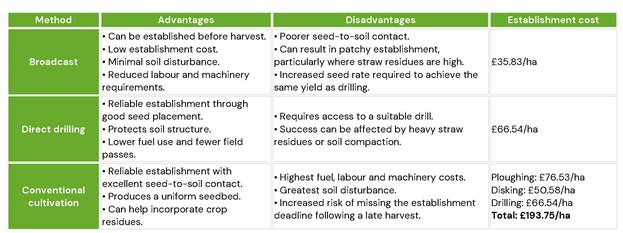
Each establishment method offers different benefits and challenges, and there is no single approach that suits every system. Although broadcasting is generally the lowest-cost option, direct drilling and conventional cultivation often provide more reliable establishment due to improved seed-to-soil contact, particularly where soil moisture is limited or larger-seeded species are included in the mix.
Planning is key for successful establishment and ensuring that EFA requirements are met.
Five top tips for successful EFA green cover establishment
- Establish as early as possible to maximise root growth, biomass production and soil benefits before winter.
- Choose the right establishment method that best suits timeliness of harvest, soil conditions, machinery and labour availability.
- Match the sowing method to the seed size for the best seed to ground contact and establishment.
- Monitor weather and soil conditions to encourage rapid germination and successful establishment. Be prepared to change seed mixtures if establishment is delayed.
- Focus on establishing a productive green cover making sure the species in the mix are appropriate for Scottish growing conditions to deliver the greatest soil and environmental benefits.
Erin McGuire, Consultant, [email protected]
Posted by SAC Consulting on 21/07/2026
