

Honey bee health: Key diseases explained
Learn more about diseases in Scottish beekeeping and if they are notifiable or non-notifiable.


Notifiable diseases affecting honey bees
Notifiable diseases are those that must be reported to the authorities. There are currently two notifiable diseases of honey bees in the UK. They are:
- American foulbrood (AFB).
- European foulbrood (EFB).
If you suspect you have one of the foulbroods you are legally obliged to report it immediately. In Scotland you should report to the Scottish Government Honey Bee Health Team via the beesmailbox. [email protected]. Failure to do so is an offence. Prompt action will help prevent the spread of disease.
When reporting, it is useful to send pictures of the brood if you can, and to be able to give a description of recent hive management.
What happens next?
The Scottish Government Honey Bee Health Inspectors will triage your report and if they suspect AFB or EFB, they will be in touch to arrange an inspection or request you send a suspect frame to Science and Advice for Scottish Agriculture (SASA). SASA perform diagnostic testing for bee diseases, and they will be able to provide instructions on how to submit samples.
You can find more information from the PowerPoint on Notifiable diseases on our Education page.
Notifiable diseases affecting honey bees
All beekeepers in Scotland have a legal obligation to report any suspicion of a notifiable disease or pest to Scottish Government Honey Bee Health Team via the Bees mailbox.
How are AFB and EFB spread?
American Foul Brood (AFB) and European Foul Brood (EFB) can be spread by infected bees swarming. This is more of an issue with EFB as bees with AFB may be too weak to swarm. You will not be immediately aware that a swarm is infected so if collecting a swarm, consider using an isolation apiary to minimise the chance of spreading disease and to allow you to assess the health of the bees.
AFB and EFB can also be spread by bees robbing infected hives or bees drifting from one hive to another. This can be reduced by spacing out hives.
There is no evidence to suggest the diseases can be spread simply by bees foraging in the same area.
AFB and EFB can also be spread by beekeepers through poor biosecurity, moving frames or bees.
In addition, AFB and EFB can be spread through honey and shared extraction equipment.
Remember AFB spores can be viable for over 50 years therefore even equipment that hasn’t recently been used can be a risk.
You can find information on how to clean your shared extractor and downloadable resources to learn more about AFB and EFB on our Education page.
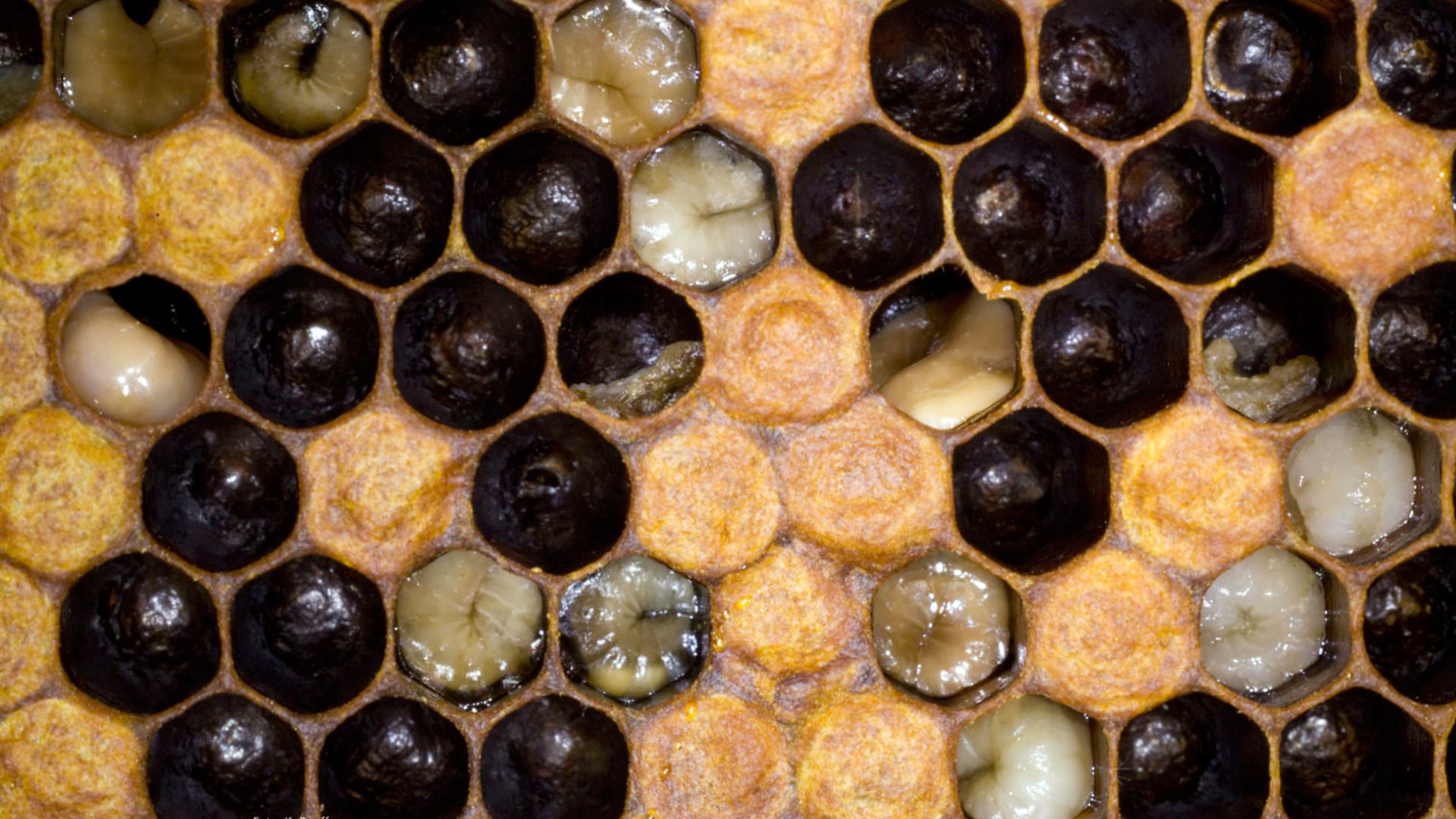
(Image shows larvae infected with EFB. The larvae appear twisted, discoloured and melted. This is unlike healthy larvae which are pearly white and segmented.)
Non-notifiable diseases affecting honey bees
Non-notifiable diseases can affect the brood or adult bees. If you find one in your hive you do not need to report it to the Scottish Government but it may affect the health of the bees and the productivity of the hive.
If you have concerns, you can contact SRUC Bee Health Advisor, Lorraine Johnston, and more information can be found in the education PowerPoint Non-notifiable pests and diseases on our Education page.
Useful links


BeeBase
BeeBase is the Animal and Plant Health Agency's (APHA) National Bee Unit website, designed for beekeepers and supporting Defra, Welsh Government, and Scotland's Bee Health Programmes.

 Go to BeeBase


Learn more about beekeeping:

Beekeeping best practice
Discover a wealth of beekeeping advice for both new and experienced beekeepers in Scotland.
Read more
Honey bee health: Key diseases explained
Learn more about diseases in Scottish beekeeping and if they are notifiable or non-notifiable.
Read more

Beekeeping education
Learn more about bees and beekeeping with our training library, blog, podcast, and other educational resources.
Read more

Beekeeping community
Explore Scotland's beekeeping community through beekeeping events, partnerships, businesses, and products.
Read more
You might also be interested in:

Dandelion Project
With the aim of re-establishing Harvest as an event on the national calendar, Dandelion brought together community development, horticulture, live music, learning, sustainable thinking and innovative arts practice to support the people of Scotland to sow, grow and share together.
Read more

Plant sciences
Working towards achieving global food security by developing resilient crop and grassland systems.
Read more

Food systems
Generating knowledge and influencing policy for safer, more sustainable, and more productive agriculture that supports healthier diets and economic growth.
Read more

Agricultural advisory
Independent advice and trusted relationships, driving improved efficiency and sustainable growth
Read more
Explore more across SRUC

Study with Us
With hundreds of courses across more than 20 disciplines, we provide the skills, experience and confidence you need to create a successful career.
Study With Us

SAC Consulting
Providing independent, research-driven, industry-leading expertise, advice and solutions for agricultural, food and land-based businesses.
SAC Consulting

Veterinary and laboratory services
Our leading experts provide support to clients in areas of animal disease, diagnosis and surveillance.
Veterinary & laboratory services