

What the 2026 Autumn Budget means for farming businesses
The 2026 Autumn Budget was delivered by Chancellor John Healey on 28 October, with the stated aim of providing stability, fiscal discipline and breathing space for households and businesses. This was a relatively uneventful affair, with numerous smaller announcements rather than any significant changes in direction.
There was no further movement on Inheritance Tax (IHT), little encouragement for business investment and limited support to address rising input costs. The extensions to fuel duty relief and suspension of certain fertiliser import tariffs are welcome, but their practical benefit is likely to be modest.
The Chancellor was constrained by manifesto commitments, the Government's fiscal rules and the need to maintain financial market confidence. The forthcoming spending review and Government's ten-year plan may provide further clarity, but this budget lacked the plan to drive UK growth.
The Office for Budget Responsibility (OBR) forecasts GDP growth of just 1.2% in 2026 and 1% in 2027. The OBR forecasts Consumer Prices Index (CPI) inflation averaging 3.1% in 2026 and 3.4% in 2027, before returning towards the 2% target in 2028.
Of greater impact to farming businesses is the subsequent Bank of England decision on 5 November to increase the bank rate from 3.75% to 4%. Forecasts disagree on future direction but a further rise to 4.25% in 2027 is anticipated before gradually falling towards 3.5% over the following two to three years. Borrowing costs may therefore remain elevated for longer than previously anticipated.
Analysis from the Andersons Centre indicates that agricultural input inflation reached 7.8% in the year to September 2026. Over the same period, agricultural output prices fell by 1.3%. Against this backdrop, the budget offers little to improve farm business confidence.
Further clarity on devolved tax matters will come from the Scottish budget on 3 December.
Summary of key changes that affect agricultural businesses
Inheritance tax and succession
There were no further changes to the Agricultural Property Relief (APR) and Business Property Relief (BPR) reforms introduced from 6 April 2026:
- The first £2.5m of combined qualifying agricultural and business assets per individual can receive up to 100% relief
- The allowance is transferable between spouses and civil partners
- Qualifying assets above the allowance receive 50% relief, resulting in an effective 20% IHT rate where the full 40% rate would otherwise apply
Although an improvement on the original £1m proposal, the reforms still present challenges for larger farming businesses. These rules are now in effect, and farming families need to understand their potential exposure.
From April 2027, most unused pension funds and death benefits will be brought within the scope of IHT.
Personal taxes, savings and property income
The budget announced a further 2% increase from 6 April 2027, on top of the 2% increase announced in the Autumn Budget 2025. Consequently, the combined increase will be 4% from April 2027.
For savings income, the new UK-wide rates will be:
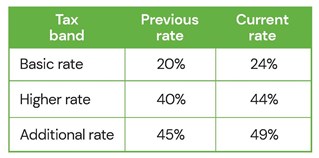
Property income is a devolved matter. The Scottish budget on 3 December should provide clarity on whether equivalent increases will be introduced in Scotland.
The previously announced reduction in the Cash ISA allowance to £12,000 has been cancelled, retaining the full £20,000 allowance.
Capital Gains Tax and Business Asset Disposal Relief
The Chancellor resisted calls to increase the main rates of Capital Gains Tax. However, the lifetime limit for Business Asset Disposal Relief (BADR), previously known as Entrepreneurs Relief, will be reduced from £1m to £500,000 from 6 April 2027. BADR allows qualifying business disposals to be taxed at 18%, rather than the normal higher CGT rate of 24%. The maximum lifetime tax saving therefore falls from £60,000 to £30,000. This reduces an already diminished relief for business owners considering retirement or disposal.
A new Founders Relief will offer a 10% CGT rate on qualifying lifetime gains of up to £10m for certain high-growth innovative businesses. However, restrictive eligibility conditions mean few traditional agricultural businesses are likely to benefit.
Capital allowances and investment
The main existing allowances remain unchanged:
- Annual Investment Allowance (AIA) – 100% tax relief on up to £1m of qualifying plant and machinery expenditure
- Full expensing – 100% relief for companies purchasing qualifying new and unused main-rate plant and machinery
Two changes affect expenditure outside these allowances:
- First-year allowance increases from 40% to 50% from 1 January 2027 for qualifying new main-rate plant and machinery.
- Main-rate writing-down allowance reduces from 14% to 12% from April 2027, slowing the rate at which tax relief is received on expenditure remaining in the main pool.
The Government presents this as an investment incentive; however, the measures are expected to increase tax revenue by around £1bn annually towards the end of the forecast period. For most farming partnerships and sole traders, qualifying machinery expenditure will continue to be covered by the £1m AIA.
The reduction in writing-down allowances is less favourable for businesses with existing capital allowance pools or expenditure that does not qualify for immediate relief.
Fertiliser tariffs and the introduction of Carbon Border Adjustment Mechanism (CBAM)
From 26 November 2026, existing import duties of approximately 2% to 6.5% on specified fertilisers will be suspended until 31 December 2027. However, the practical impact may be considerably smaller than the headline suggests.
A significant proportion of fertiliser imported into the UK already originates from countries where these tariffs do not apply. AHDB reports that, during 2026 so far, 100% of ammonium nitrate imports and approximately 57% of granular urea imports came from the EU, with much of the remaining urea originating from countries such as Algeria and Egypt, which also benefit from tariff-free arrangements. Consequently, removing tariffs is unlikely to result in a substantial reduction in prices.
The more significant issue may be the introduction of CBAM from 1 January 2027. CBAM introduces a carbon tax on certain imported goods, including fertilisers, designed to ensure imported products face comparable carbon costs to UK manufactured goods and discourage production moving overseas to avoid UK environmental costs. The impact in 2027 is expected to be low, with anticipated increase over an eight-year period as the policy takes full effect.
Employment costs
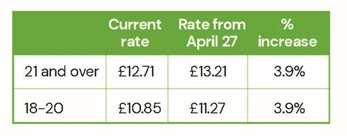
Increase in National Minimum Wage and National Living Wage:
Other measures
- The 5p per litre reduction in road fuel duty will continue until 1 July 2027
- The additional 3.7p per litre reduction in red diesel duty will also continue until 1 July 2027
- Changes to Self-Assessment payments on account
- From April 2029 will become smaller, more frequent payments throughout the year
- The practical effect is that tax payments will be brought closer to the point at which income is earned, more in line with PAYE on payroll
- Mandatory VAT e-invoicing from April 2029
- Increased use of HMRC digital systems and compliance monitoring
Andrew Coalter CA, Senior Agricultural Consultant and Area Manager, [email protected]
Posted by SAC Consulting on 19/11/2026
