

Unlocking the Value of Layer Manure
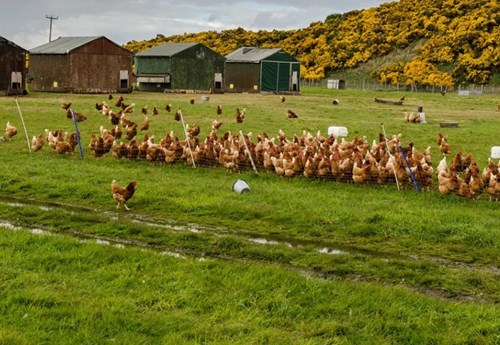
Layer units have significantly increased in size over the past decade, producing large volumes of manure. With significant growth in free range eggs recently, we are now seeing new poultry sheds springing up around the country, this also means that availability of layer manure or ‘hen pen’ will increase. While there are some farmers who may shy away from using it, it’s reputation as ‘rocket fuel’ is well deserved, with relatively small applications capable of supplying good levels of nutrients very quickly. As margins tighten, could hen pen offer an opportunity for your business to reduce fertiliser costs?
Most poultry farmers realise the value of their hen pen and will try to utilise as much as they can on their own holdings although volumes produced will, in many cases be greater than can be spread on the holding. There are also holdings with very little additional land and will need to export much if not all of their manure production.
Layer manure contains high levels of several nutrients and unlike other farmyard manures (FYM), nutrient availability is higher. While standard values can be a useful starting point, just like other manures getting a sample of the hen pen analysed can give a much more accurate indication of nutrient content. This allow applications to be better targeted and avoid unnecessary over-applications.
Using the standard values from Scotland’s Farm Advisory Service (FAS) technical note “Optimising the application of livestock farmyard manures and slurries”, one tonne of layer manure contains the following nutrients with the availability to the following crop also shown:
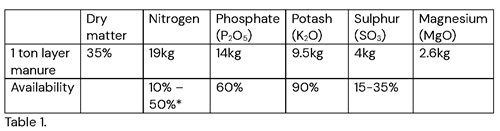
*Depends on incorporation timing (over or under 24 hours), soil type and time of year of application.
Nitrogen availability to the following crop can vary significantly due to a number of factors including time of year, speed of incorporation, soil type and ground cover. Around 30-50% of the total nitrogen is potentially readily available to crops, being in the forms of uric acid and ammonium-N. Unfortunately this also means that it is more susceptible to losses both to the air through volatilisation and through leaching meaning that careful planning is required to get the optimum benefit from the application and to minimise losses to the environment.
Most of the phosphate and potash will be available to the growing crop, with the remainder being added to soil reserves. Good levels of sulphur are also found in layer manure, with some available to the crop. Layer manure will also supply good levels of magnesium, although this should mainly be thought of as helping maintain soil reserves. As with all manures, applications should be planned in tandem with using soil analysis and it is important that pH is at recommended levels. When soils are at a lower than optimum pH, nitrogen and phosphate will not be utilised efficiently, increasing the risk of nutrients being wasted and lost to the environment.
Taking this a stage further, what does this mean at field level, both in terms of nutrients and also financially? Taking typical application rates of 6.25t/ha (2.5 tons per acre) being applied in the spring onto a grass field with an organic mineral soil, the following nutrients are supplied with their financial value also shown at current fertiliser prices:
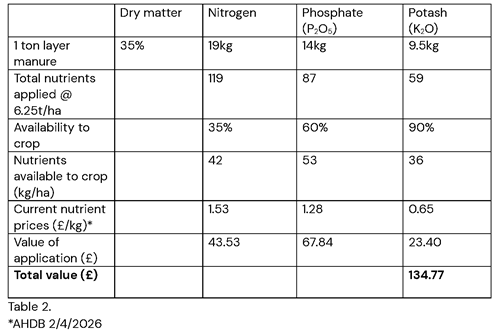
Using layer manure offers the opportunity to supply good levels of nutrients although there are several considerations.
Due to its high level of readily available nitrogen, there are several restrictions for those in Nitrate Vulnerable Zones (NVZ) areas in terms of storage, application timings and rates as well as periods of the year when no spreading can occur to reduce the risk to the environment. Planning timing of applications and requirements beforehand can therefore help decide when to take it onto farm, particularly if storage is an issue. Records must also be kept of any imports onto farm along with spreading dates and rates etc.
Spreading should be undertaken in an even manner, avoiding lumps left lying in fields. No grazing should be undertaken for at least four weeks after an application. Consult with the latest Farm Assurance scheme guidance, to ensure compliance when applying layer manure as a fertiliser.
Layer manure offers an opportunity for farmers to access an excellent source of nutrients which can provide a quick response in grassland and arable crops alike. With global influences meaning that fertiliser prices are rising significantly with availability also becoming challenging, perhaps it is time to consider giving hen pen a try.
George Chalmers, Senior Consultant, [email protected]
Posted by Unearthed News on 17/04/2026
