

Progressing industrial hemp fibre cropping in Scotland
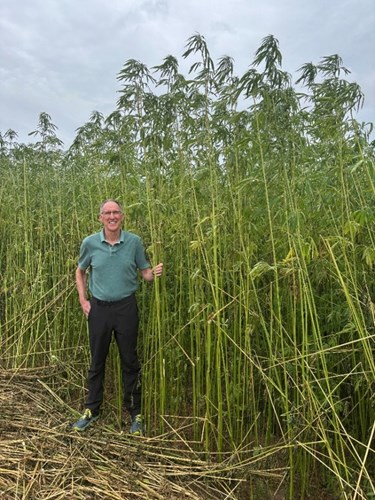
Industrial hemp is gaining renewed attention in Scotland as a versatile crop with the potential to support farm resilience, supply low‑carbon industries, and contribute to climate goals.
A report delivered by SAC Consulting, funded by IBioIC and Scottish Enterprise, highlighted hemp’s role as a valuable break crop, a renewable raw material for manufacturing, and a means of carbon sequestration.
The study explored the feasibility of setting up a grower co-operative supplying a decortication and cleaning plant, processing up to 12,000 tonnes annually from 2000ha, in turn supplying manufacturers and retail distributors. Capital cost of the decortication and cleaning plant was estimated at around £5 million, preferably with significant investment from farmers to obtain added value from the hemp crop.
This primary processing, decortication and cleaning involves mechanically removing the ‘bast’ fibre from the woody core (‘shiv’ or ‘hurd’), producing fibre for insulation products and shiv for applications hempcrete, horticultural growing media, animal bedding, and briquettes.
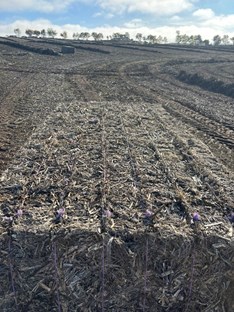
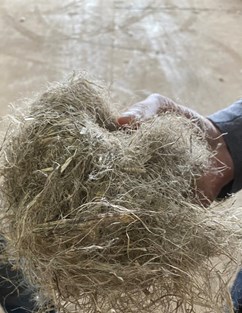
With two commercial seasons now completed in Scotland, what have we learnt so far about the requirements for establishing industrial hemp production co-ops in Scotland?
Sufficient processing capacity
Although manufacturers such as IndiNature are based in Scotland, there remains a gap in primary processing capacity. High capital costs, uncertain construction demand, and limited early-stage incentives have slowed investment in decortication facilities across the UK and EU. Increased and more consistent demand, particularly from the construction sector, would significantly reduce this barrier.
Demand for hemp fibre products
It is hard for biofibre products, such as building insulation and soundproofing to compete with products derived from fossil fuel that have established manufacturing infrastructure and long-standing markets for their products. The hemp fibre products superior breathability and moisture repelling properties have found outlets in retrofitting older buildings and social housing schemes. Properties have been built using hempcrete, but this is niche as it requires skilled tradesmen and appeals to more ecologically conscious consumers.
International examples, such as the Netherlands’ Green Inclusive initiative, demonstrate how targeted incentives can stimulate demand for carbon-negative materials. Developing similar approaches in the UK could help unlock markets for Scottish-grown fibre.
Capital cost of processing facilities
The 2024 report estimated the cost of full decortication and associated processing facilities to be in the region of £5m to £6m, though lower-cost alternatives (£1-1.5 million) are emerging. These systems process hemp into compressed boards using shorter retting periods, potentially reducing harvest risk.
Hemp required for this process can be baled after a shorter retting period, which would help de-risk harvest. While they may offer a practical entry point, further work is needed to assess their efficiency and scalability.
Investment support
Some pump priming funding will be necessary to help with capital costs and to help cash flow through the plants start up years. A farmer co-operative structure could support coordination, quality assurance, and market development. Partnering with existing agricultural co-operatives may help reduce overheads and accelerate progress.
Encouraging farmers
Farmers will need to see a profit from the crop that is competitive in the rotation in addition to the known benefits to yield in crops following hemp. Industrial hemp can involve minimal work after sowing, but will require contractors with specialist cutting equipment, tedders and the optimum type of baler.
Dutch farmers have support payments for low carbon crops that helps underpin their income from hemp. Green Inclusive offers one or multi-year cultivation contracts in which a fixed price per tonne of dry matter yield is agreed in advance. In addition, the grower receives an additional CO₂ payment per tonne of dry matter.
Could a carbon payment evolve for crops that lock up carbon long term to reward farmers for their contribution to reduction of greenhouse gas emissions?
Availability of seed
Seed supply continues to be constrained, with delivery delays posing risks to timely sowing. However, there has been recent progress: Precision Plants, a UK agri-biotech company, has secured £912,000 through the Defra programme to develop new hemp varieties for grain, fibre and dual-purpose use. These will progress from laboratory development through field trials, with the aim of gaining approval for inclusion in the UK’s official crop variety register.
2025 harvest reflections
The 2025 season illustrated both the potential and challenges of hemp production in Scotland. The crops grew very well during a favourable growing season and reached quite impressive heights by August. However, the impact of Storm Floris bending and brackling the stems, following a dry August that delayed retting and then a wet September, led to difficult baling conditions that stretched into October.
Brackled stems meant longer fibres that often-blocked baler intakes and slowed down work rate. The wet September and October also left a proportion of bales above the normal target moisture content of 15-17oC. Long time growers in England experienced similar conditions however and commented upon just how atypical the 2025 season was and do nonetheless still remain committed to the crop. The 2025 crop will be sent to Yorkshire, the nearest facility, for processing.
Industrial hemp has clear potential in Scotland but unlocking it will require joined-up progress in processing capacity, market development, and policy support. With the right investment and incentives, it could become an important crop for both farm resilience and the transition to a low‑carbon economy.
Mark Bowsher-Gibbs, Principal Consultant, [email protected]
Posted by SAC Consulting on 20/05/2026
