

New approach in Orkney to weed control in grassland
In Orkney you do not have look far to catch site of the dreaded broadleaved dock. Our fertile grasslands, slurry-based livestock systems and agri-environment schemes have helped this troublesome plant to flourish in recent times.
Broadleaved docks are no friend of the livestock farmer, reducing grass production, being unpalatable and reducing silage quality. They have only 65% of the feed value of grass and a 10% infestation can reduce grass yield by the same amount.
Their seed can lie dormant in the soil for up to 70 years before exploding into life when triggered by favourable conditions e.g. temperature, moisture and light. This often happens after the soil has been disturbed, typically after a field has been ploughed when the seed is brought to the surface and where ground has been poached/damaged.
A single dock plant can produce up to 60,000 seeds a year. Dock seeds are massively robust being able to survive passage through ruminants and remain viable in hay, straw, and manure.
There are several chemicals on the market approved for controlling docks, however, the most effective ones are expensive, potentially harmful to the environment and kill our friend the clover. With fertiliser costs higher than ever, it has never been more important to have clover rich swards which can fix the equivalent of 180kg N/ha from the atmosphere. Furthermore, every 10% increase in clover content of a grass sward will raise the crude protein level of the silage by 1%.
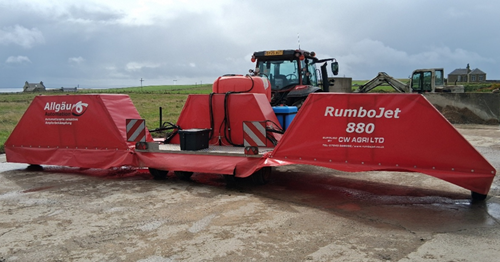
Three separate farm businesses in Orkney have each recently invested in different tractor mounted precision spot spraying systems to combat the spread of this troublesome weed and others. A SKAi spot sprayer, a RumboJet 880 and a Rumex RXF600.
These spot-spraying systems are powered by artificial intelligence, using cameras to identify and target individual weeds in real-time offering maximum precision so that treatments are only applied where needed. This massively reduces chemical use compared to conventional blanket spraying of whole fields.
The SKAi spot spraying system was developed and is supported through SoilEssentials. It uses a combination of GPS and five cameras to control 28 separate nozzles, optimising herbicide use and cutting costs. The machine has a separate tank for chemical, so it only mixes what it needs. It is also capable of spraying nettles, rushes, thistles and ragwort as well as docks. The system is available as a factory-integrated solution on a SoilEssentials 9m, 12m, 15m or 24m mounted sprayer or can be fitted to other branded sprayers. The Rumex RXF600 is 6m wide and mounted on the front linkage of the tractor and is distributed by Opico. It has three horizontally aligned cameras for weed detection and 90 individual spray nozzles. With individual nozzle control, the minimum spray width is 70 mm, allowing even the smallest leaves to be precisely treated. The precise spraying control similarly to the SKAi system ensures maximum efficiency and optimises herbicide use.
The tractor mounted RumboJet 880 sprayer was developed in Germany by the Allgäu Automation. It is 8.8m wide and has a canopy around it to aid the 6 - camera detection system (capable of capturing up to 90 pictures per second) and to reduce wind blow from the 88 nozzles. Like with the other systems the Rumbojet 880 uses a computer-operated spot-spraying system, specifically designed to target individual weeds in grass swards. The RumboJet 880has been programmed to identify weeds at various growth stages including docks, ragwort and thistle.
There are optional extras available with each system which can enhance the performance and user experience depending on end user demands and budget.
It was not possible to fairly appraise the three machines as they have not been operational for long enough, however, initial results look very encouraging.
The SKAi spot sprayer has to date covered 2456.5 acres (994ha) in Orkney with excellent results. Fields with very heavy weed populations at different growth stages may require a follow up application but, in most situations when conditions have been good, this is not necessary. Only Forefront T was used due to its effectiveness at controlling docks as well as thistles and ragwort. Only 789.4 litres of this chemical was applied to the 994ha at the label recommended concentration of 2l/ha. The % of spray saved when comparing actual chemical used by the spot sprayer compared to a blanket spray approach was 60.3%
The overall average cost of spraying including the herbicide equated to £39.89/acre which is significantly less than £43.21/acre which would have been charged if a conventional approach was adopted.
Using the contractor’s own figures, he calculated the total cost of spraying the 994ha with the spot sprayer was £97,985 compared to £106,156 if he were blanket spraying.
However, arguably the greatest benefit of using this type of system is the 600ha of grass and clover which were untouched with chemical and left to grow totally unchecked.
Five top tips
- Assess your fields for weeds in the spring to determine if action is required.
- If chemical control is necessary, pick an appropriate herbicide and apply it at the optimal growth stage for the target weed.
- Seek advice from a BASIS qualified advisor and ensure the spray operator has PA1 and PA2 qualifications.
- Consider topping fields before they go to seed if no other control method is available.
- Prioritise control of weed seeds in silage and hay crops where they will contaminate the slurry and dung and be distributed over the farm.
Graham Scott, Agricultural Consultant, [email protected]
Posted by SAC Consulting on 21/09/2026
