

The 2025 Silage Crop – Making the Most of a Challenging Year
With silage being the main component in the majority of ruminant rations over the winter months the quality of forage is of upmost importance for the overall performance. Quantifying the quality is essential to ensure all dietary requirements are met particularly for those animals in a high nutritional demand e.g. late pregnancy, lactation, growing youngstock and finishing stock.
A summary of results for all silages submitted to the lab by SAC Consulting offices between July 2025 – January 2026 can be found in table 1 below. Compared to 2024 average dry matter (DM) has increased from 35% to an average of 39.1% with energy down from an average for all silage of 10.5 MJ/kg DM to 10.1 MJ/kg DM. Protein has increased on average compared to previous years however at 12.2% (although as normal the range for all is vast!).
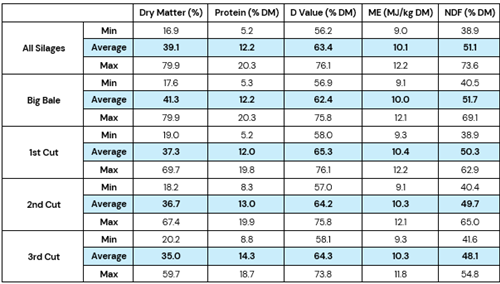
Table 1: Silage analysis summary between July 2025 – January 2026 (all SAC Consulting).
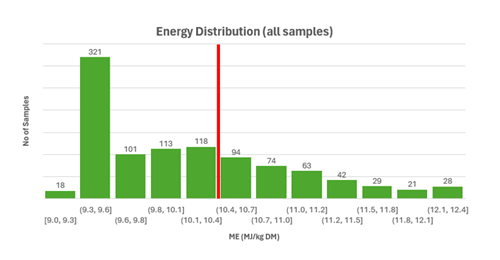
The lower energy levels are likely due to the dry spring stressing pastures leading to many grass crops reaching maturity faster than expected. Big bale silage has seen the biggest drop at 10 MJ/kg DM on average. Overall, 65.5% of all samples submitted were 10.4MJ ME or lower. The result is that energy is likely to be the first limiting factor to performance in many rations this year and pre-calving/pre-lambing. Therefore it is crucial to ensure that rations are appropriate in the run up to calving and lambing. Failing to meet late gestation energy (and protein) requirements will affect colostrum quality and quantity, leading to a negative impact on neonatal health and survival as well as longer term growth rates.
Feeding Low Energy Forages
Feed intake in ruminants is heavily controlled by ration digestibility or “D Value” if we are looking at silages, in simple terms the lower the D Value the lower the total dry matter intake of that forage. This is predominantly due to the higher level of fibre measured as NDF in low D Value forages which slows down rumen passage. Dry cows can manage well on forage with a lower D Value (>56%) post weaning in mid pregnancy, however in late pregnancy (final six weeks) and lactation this requirement increases to nearer (>62.5%). For sheep and all growing and finishing stock we should be aiming for highly digestible forages (>68%) where possible if aiming to minimise supplementation.
Below this it is vital that the ration is supplemented appropriately with another feed of higher energy density such as cereals, high energy compound feeds, molasses, co-product feeds (draff, bakery/food processing by products, veg waste etc). Where forages are highly digestible supplementary feed typically will replace some forage in the ration but for forage low in digestibility such as those we have seen this year supplementary feeds are typically fed in addition to forage to increase overall digestibility of the whole diet and thus aid performance and growth. For more information on how to best balance your forage please contact your local SAC Consulting office.
Looking to 2026 – How Can We Best Optimise Quality in Adverse Conditions?
Our biggest challenge to silage making in the UK is typically the weather, a factor which is unfortunately out with all our control. Energy is determined mostly by stage of maturity at cutting but also available sugars. If aiming for a highly digestible forage, we want to be aiming to cut when the crop reaches its third leaf stage before stem extension and flowering. There is a trade-off between quality and quantity as the grass starts to head, yield will increase. However, once headed D Value declines by 0.5% per day. Delaying cutting by one week leads to 3.5 percentage units lower D Value, equivalent to 0.6MJ/kg DM of metabolisable energy. Cutting in the afternoon will often ensure higher available sugar levels for fermentation but time of cutting should also be adapted to conditions and required wilting time.
Cutting in a Dry Season
- Cut in morning (after dew has lifted) and aim to pit/bale the crop in the afternoon in particularly hot weather to reduce nutritional losses.
- Ensure nitrogen has been properly used prior to cutting – normal uptake is 2.5 kg N/ha = 2 unit/acre/day however this may be reduced in the absence of moisture.
- Aim for a short, sharp wilt in hot weather <24hrs. If the crop is high in clover you may want to leave it longer.
- If extremely dry avoid tedding/conditioning to limit nutritional losses and leaf shatter.
- If using an additive aim for one more suited to a dry crop to aid fermentation and limit heating/moulds.
- Compaction can be a challenge in a dry crop – aim for six wraps on bales, well rolled pit.
Cutting in a Wet Season
- Cut in afternoon when there is a decent weather window planned aim to bale/collect 24hrs later.
- Ted the crop immediately post cutting to aid moisture loss. Conditioning the crop may also increase wilting by +20%.
- If using an additive aim for one more suited to wet crops as the challenges when ensiling will differ compared to a dry crop.
Lorna Shaw, Ruminant Nutritionist, Lorna.Shaw@sac.co.uk
Posted by SAC Consulting on 18/02/2026
