

Schmallenberg Disease – What to Watch for This Spring
Schmallenberg disease is a viral disease that is spread by biting midges. Transmission of the disease therefore occur during the midge active period, which is typically April to November. The virus can cause acute disease in cattle with fever, diarrhoea and milk drop. The virus causes deformities in lambs and calves if pregnant animals are infected at the susceptible period of pregnancy (sheep 25-50 days, cattle 62-180 days). Earlier infection may cause early embryo deaths and abortion, and thus high barren rates
The virus was circulating in Scotland during the 2024 midge active period. Several cases of foetal abnormalities were seen in the spring of 2025, and plenty of evidence of exposure to the virus was found in herds and flocks in large proportion of the country.
Following infection, natural immunity develops which lasts two to three years. This is why we see waves of the disease a few years apart, although cases can certainly occur every year.
Be aware that the deformities can cause lambing or calving difficulties. This spring, if something doesn’t feel right, consider that the lamb or calf might be deformed. Call your vet in this instance.
The maps below show locations of positive Schmallenberg Virus (SBV) cases in Scotland between January and July 2025.

Location of SBV antibody positive cases (red cattle, blue sheep). This indicates exposure to the virus.
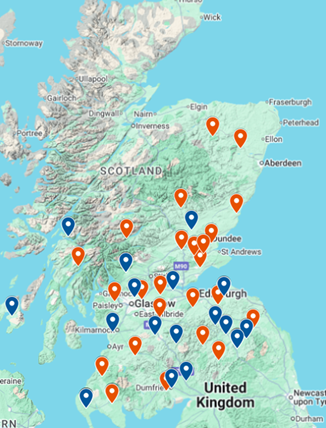
Location of deformed foetuses confirmed to be due to SBV infection (red cattle, blue sheep).
Source: Martin Tomlinson, University of Glasgow
Preventing the disease is difficult as there is no vaccine currently available in the UK. Some preventative measures to consider include:
- Shifting mating until later in the season to a time when midge pressure is lower could help reduce the risk of infection.
- Housing animals, use of midge netting, or use of insecticides (insect repellent) are not going to be completely successful, and not practical in most circumstances, but may be considered on a case-by-case basis, particularly for high value animals.
- Midges breed in wet conditions so locating muck heaps for example way from stock might help.
Alywen Jones, SRUC Veterinary Investigation Officer, Alwyn.Jones@sruc.ac.uk
Posted by SAC Consulting on 16/03/2026
