

Changing yellow rust resistance in winter wheat
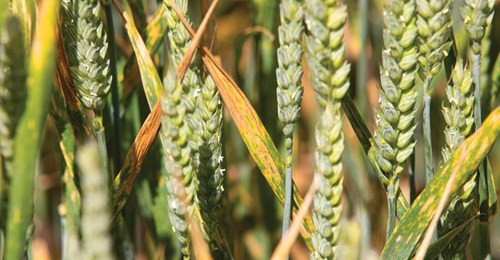
Scottish wheat growers have seen a very significant change in the resistance ratings for yellow rust over the previous two growing seasons. The spring of 2025 saw the emergence of a new strain of yellow rust that had overcome one of the most important resistance genes used in modern wheat varieties - the Yr15 gene. This has significant implications for winter wheat growers in Scotland, with the breakdown of this resistance causing major revisions to variety resistance ratings.
Variety resistance ratings are a key tool for cereal growers. However, in early 2025, unusually high levels of yellow rust started to be seen in the North of England in varieties that were previously thought to have high levels of resistance for this disease. This phenomenon was quickly seen in other areas of the UK too. In June 2025, researchers from the UK Cereal Pathogen Virulence Survey (UKCPVS), confirmed that a new yellow rust strain had developed virulence against the Yr15 resistance gene. This gene, which provides protection from the seedling stage through to maturity, had been widely incorporated into modern wheat breeding programmes, and was regarded as one of the most effective sources of resistance. In the 2025 growing season, Scotland’s Farm Advisory Service (FAS) estimated that the Yr15 gene was present in nearly 60% of the wheat area grown in Scotland, while AHDB estimated that approximately one third of wheat varieties on the recommended list contained the Yr15 gene. The widespread use of this gene means that the consequence of its breakdown has severe repercussions for wheat growers.
This breakdown in resistance to yellow rust followed widespread and unexpected infections in varieties that had previously shown strong resistance. Often, when disease resistance breaks down, it happens gradually over a period of time. In this case however, the fall off in disease resistance was both immediate and widespread. Not only did yellow rust infection start early in 2025, but agronomists also reported early-season infections in varieties which until that time had demonstrated good plant resistance. Fortunately, early fungicide programmes generally kept disease levels under control and prevented severe yield loss in most cases. The concern moving forward is that growers may no longer be able to rely on varietal resistance alone. This raises important questions about future variety choice and disease management strategies
As a consequence of this development, there has been a rapid revision of yellow rust disease resistance ratings for several winter wheat varieties. However, not all varieties that carry the Yr15 gene have been affected equally. Some varieties contain multiple resistance genes (known as gene stacking) which continue to provide protection. Where additional resistance genes remain effective, varieties have generally retained reasonable levels of protection against yellow rust, despite the loss of Yr15. These varieties have often only seen modest revisions to their disease ratings. However, those varieties more reliant on the Yr15 gene have seen significant shifts. As a result of these dramatic changes in variety resistance to yellow rust, the AHDB published updated recommended list resistance scores during August of 2025. Some varieties lost between two and five resistance rating points, reflecting the breakdown of Yr15-based protection. Because the yellow rust population had changed so dramatically, AHDB also based its updated ratings solely on 2025 trial data rather than the normal three-year dataset. The decision reflected the fact that historical data no longer accurately represented the current yellow rust population and the performance of different varieties against the new strain of the disease.
So, what are the implications of this for Scottish wheat growers? Variety selection is still one of the most important decisions that a grower makes regarding disease risk, however yellow rust ratings now need to be interpreted with care. Greater emphasis will be placed on varieties with multiple sources of resistance, and growers should ensure that they are using the most up to date data when choosing their varieties. In addition to taking care with the choice of variety, wheat growers in Scotland should regularly check their crops from late winter onwards. The disease is most likely to appear in sheltered areas and field margins first so these areas should be checked diligently. Early detection of the disease is important to prevent it spreading rapidly through the crop. A robust fungicide program will also need to be maintained going forward with more farmers now opting for a T0 fungicide application where conditions favour early disease development. Farmers also need to be aware of the time interval between fungicide applications, ensuring that plants remain protected. Where an infection of yellow rust is found, it is important to treat this as quickly as possible before it can spread through the crop.
Looking ahead, the loss of Yr15 resistance highlights the constantly evolving nature of yellow rust. As SRUC plant pathologists have noted, yellow rust populations can adapt rapidly and overcome widely deployed resistance genes. Plant breeders and researchers are already working to identify new sources of resistance. For Scottish wheat producers, the message is clear: the era of relying heavily on a single yellow rust resistance gene has ended. Future resilience will depend on a broader combination of diverse genetics, a robust fungicide programme, crop monitoring and surveillance of the changing yellow rust population.
Five Top Tips
- Always use the most up to date variety resistance ratings.
- Choose varieties with multiple resistance genes if possible.
- Monitor crops regularly.
- Act quickly when yellow rust id found.
- Maintain a robust fungicide programme.
Useful links
Alan Bruce, Senior Consultant and Area Manager, [email protected]
Posted by SAC Consulting on 17/08/2026
