

Beef Market Commentary and Outlook
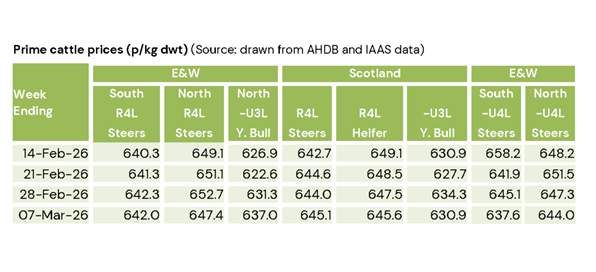
Finished beef prices for 2026 have started the year strong. As of mid-January, for week ending 24 January Scottish R4L grades were sitting at 650p/kg/dwt (+44p from the same week in 2025). However, finished prices have started to wane, on the back of reduced consumer demand, as consumers opt for low value cuts and mince. Despite processors reporting tightening cattle supplies, finished beef prices eased back throughout February. For week ending 21 February prices for Scottish R4L steer grades were sitting at 644p/kg/deadweight, roughly on par with the same week last year. GB deadweight steers have fallen by 25p/kg in the past three months to average 636p/kg in mid-February, while liveweight finished steers have dropped slightly to 373p/kg. GB February 2026 slaughter data shows prime cattle is down 1.8% compared with February 2025. In early March, prime cattle in Scotland averaged 642p/kg deadweight at abattoirs and 378p/kg liveweight at auction marts.
Looking ahead
At the time of writing Scottish finished prices are sitting around 645p/kg deadweight (R4L), with Angus sired cattle still maintaining 10p premium. Figures from AHDB show GB deadweight prime cattle prices dropped back by 2p/kg on the week (week ending 7 March) to sit at 635p/kg. Cost of living pressures continue to push consumers towards cheaper protein options, particularly chicken with consumer demand for beef being significantly reduced. Reports suggest that despite lower numbers of cattle coming forward that processors are looking to reduce prices and it is unlikely there will be a lift in beef prices soon.
Store cattle
Store cattle (12 months plus) continue to meet a buoyant demand. Towards the end of January, trade for heavy forward stores eased back most likely linked to the fall in deadweight price. However more recently despite finished prices easing back, store cattle continue to sell well, with current values sitting around £120 - £150 a head higher than this time last year. Although store cattle prices look good on paper, it is worth remembering that production costs (both variable and fixed costs including finance/borrowings) have for many producers significantly increased.
Although cold weather and wet soil conditions earlier on hampered grass growth, grass is now growing nicely and with turnout not too far away, livestock marts anticipate that trade for store cattle will continue to be buoyant with no signs of easing.
Cull cows
Although the gap between 2025 and 2026 GB pricing has narrowed, cull cow trade remains firm. Mince sales are undoubtedly driving the demand for cast cows. Scottish deadweight prices (R4L) were sitting at 555p/kg for week ending 31 January and have continued to trend upwards, fetching record highs for the time of the year, currently sitting favourably around 560p/kg/dwt. For week ending 7 March GB cow averages were up 31p on the same week in 2025.
Spring bull sales
Cautious optimism probably best described how pedigree breeders felt ahead of this year’s February Stirling bull sales. More than 700 pedigree bulls, across nine breeds were catalogued for sale – the highest number since 2022. Trade at the sale was undoubtedly underpinned by the exceptional beef prices in 2025 and optimism was justified as sellers were largely met with increased demand from commercial buyers with increased clearance rates and breed averages for several breeds. 104 Charolais bulls sold to average £11,760, with no fewer than 41 lots hitting five-figure prices, while 106 (+12 from Feb 2025) Simmental bulls met a 92% clearance rate, with the breed averaging £12,294 (+£2,462 on the year).
In recent years, the Angus breed has fallen behind their continental counterparts, however the movement towards easier calving and a more maternal native type of cow that can be extensively grazed on areas of hill using technology such as virtual fencing has led to a surge in demand for native animals. A new breed record and record average (+£3,020 from last year’s sale) was achieved for the breed. Calf registration data recently released from AHDB highlights growth for the AA breed with registrations of Aberdeen Angus X cross calves in 2025 significantly increased with the data also highlighting significant growth for the breed in the past decade.
Sarah Balfour, Beef Consultant, Sarah.Balfour@sac.co.uk
Posted by SAC Consulting on 16/03/2026
