

Exploring perceptions of nature-economy relationships in Scotland
Blog post by Dr. Seb O’Connor, Lecturer, School of Natural and Social Sciences and Joana Ferreira, Lecturer, School of Natural and Social Sciences
Over the last 4 years, we have been exploring how people in Scotland understand the relationship between nature and the economy, and how these perspectives could help shape a more sustainable future.
Terms such as the ‘circular economy’, ‘green economy’ and ‘bioeconomy’ are increasingly common in policy discussions, research and the news – even SRUC’s strategy centres on the ‘natural economy’. However, these terms can point towards very different ideas about how economic activity relates to the natural world.
Through our research, we wanted to understand these different perspectives, explore the changes people would like to see and consider how language could help shape conversations about the economy in the future.
Our work formed part of a wider Scottish Government funded RESAS research project, People and Nature.
We have also recorded a podcast in which we discuss our research journey and key findings. You can listen to the podcast here Exploring perceptions of nature-economy relationships in Scotland - The SRUC Podcast.
What we did:
The relationship between ‘nature’ and ‘economy’ raises fundamental philosophical and ethical questions. How we understand these questions depend on our worldviews, values and perspectives. We designed three phases of work to explore these different perspectives and reveal a wide range of understandings of what the economy is as well as what the economy could, or even, should be with differing implications for our relationship with nature.
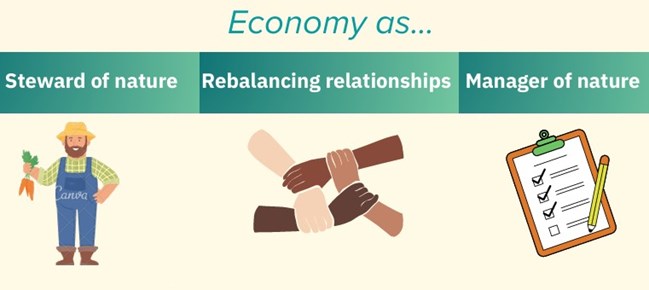
Exploring existing understandings of nature-economy relationships through a research method known as Q-Study to explore how civil sector workers in Scottish Government. We found the three main ‘narratives’ existed across participants. There were those that understood the economy as:
- ...stewardship of nature was identified in this narrative as key responsibility of economic systems. In this narrative, the limits to economic growth were well recognized and reductions in material throughput identified as key.
- …balancing relationships with nature – This narrative placed a strong emphasis on making economy more ‘circular’. This was articulated through importance of reciprocal human-nature relationships and justice-oriented languages.
- …manager of nature – This narrative felt that economic systems just need to manage nature better (like a future investment). Here, quantifying nature and accounting frameworks like Natural Capital were regarded as most helpful ways to do that and there was a belief that costs could be internalised into the market.
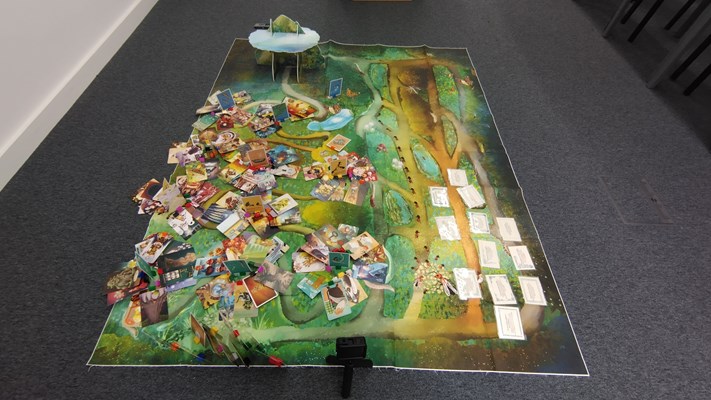
Imagining alternative visions of nature-economy relationships – In this second phase, we explored what alternative relationships between nature, and the economy could look like in practice. We held workshops with people working on sustainability issues, including activists, educators and local community groups across Scotland. We used a game-based approach called ‘Change Walk' to encourage participants to think about the changes they wanted to see and what would need to happen to make those changes possible.
The workshops generated a wide range of ideas about how we could reshape our relationship with nature. Given the breadth of these discussions, we encourage readers to explore our research poster to find out more about the approach and findings. You can read more in our research poster on imagining alternative nature-economy relationships.
A deliberative dialogue on the role of language in facilitating changes in nature-economy relationships – In this final phase we started from the premise that economic systems need to align more closely with sustainability goals and planetary boundaries. From there, we considered how language can be constructive or conflicting in discussions about change. We brought together participants working at different levels of governance, including local community organisers, regional environmental sector professionals and people working on policy and strategy at a national level. These discussions highlighted the importance of tailoring language to different audiences and connecting issues to the things that matter to them. Broad climate goals and targets can feel very different for different groups, so we need to consider how messages are communicated and understood. We also focussed on balancing conversations around what needs to change with more positive and hopeful messages about the benefits of building economic systems that recognise ecological limits and capacities alongside being fairer for people.
Across the first two phases of our research, participants found it unusual and rewarding to have the time and space to reflect on many of the questions we had been exploring. There was a shared sense that in the day-day of their professional lives, even if working directly on sustainability issues, there was little to no space within existing institutions and governance systems to reflect on the goals and values that underpin their work and the direction of practices that variously constitute the economy.
For us, this emerged as one of the most important messages from the research. Reflexivity within institutions have been advocated by many environmental political theorists as a fundamental component of a democratic political system to change course at the scale that we need in times of climate and ecological crises. Our research provides evidence of the importance of creating space for reflexivity within Scotland’s institutions and governance systems in order to help transition to a more sustainable and fairer economy.
Posted by SRUC on 22/10/2026
