

Use of Common Grazings: Implications for Graziers and Grazings Committees
The Rural and Islands Insights Report 2025 offers comprehensive evidence based on the changing conditions shaping Scotland’s rural and island communities. This includes demographic trends, service access, economic pressures, and the transition to new agricultural and environmental support frameworks.
It highlights persistent challenges, for example, rising costs, ageing populations, and declining agricultural activities. It also highlights emerging opportunities linked to climate action, biodiversity restoration, and the reform of agricultural policy under the Agriculture and Rural Communities (Scotland) Act 2024.
While the report covers a broad range of themes, one of its most significant insights in crofting relates to use of common grazing shares for claiming agricultural support namely Basic Payment Scheme (BPS) and Less Favoured Area Support Scheme (LFASS).
The report’s key findings on common grazings
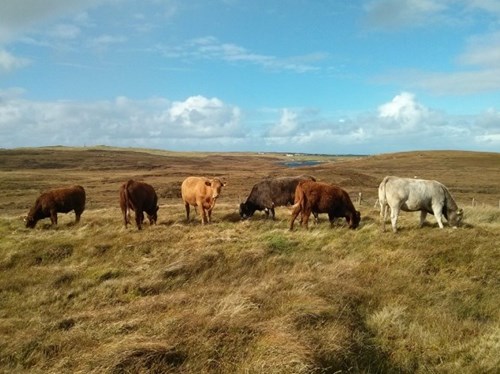
Common grazings hold exceptional environmental value, containing large shares of Scotland’s nationally important peatlands and land designated for importance to nature. They also remain culturally and economically significant to crofting communities.
Common grazings are vast. The report states that the 950 mapped grazings cover over 503,000 hectares. However, SAF/IACS claiming activity on many grazings has declined, and only 45% of shareholders submitted agricultural support claims in 2022.
It is very important to note that there is often no clear connection between overall grazing density and shares claimed on any common grazing. However, this identified underutilisation likely indicates two scenarios
- Under-use and lack of grazing on certain common grazings
- Under use of the shares for claiming Basic Payment Scheme and LFASS when the common grazing is in fact grazed at the optimum
Understanding the differences between scenario A and B is crucial for remedying them. Scenario a would involve general measures to encourage activity as a whole and encouraging use of the common grazings.
However, scenario B is more nuanced and will be the focus of the rest of this article.
Asymmetric allocation of land
Let’s imagine a common grazings called ‘Adrift’ as an example.
Key facts
- Common grazings name ‘Adrift’
- 1500 ha in size. BPS payment region 2
- 20 shares each 75 ha in size
- Souming (allowed grazing level in regulations) 1100 sheep in total or 165 cows in total (or a combination of both)
- There are only five active crofters. They only claim one share each. However, they do between themselves have 1000 sheep and 15 cows that graze the common.
Therefore, in relation of BPS the crofting community is only getting 25% of the Basic Payment they could be receiving as they don’t have the remainder of the land on their SAF applications used although the ground is being used at the level required for BPS and LFASS.
As a result, they are gathering sheep and moving cattle across unsupported ground that does not produce a payment.
LFASS at present is not so clear cut as some graziers may have benefited from having a higher stocking density on paper rather than reality. However, this support payment situation could become more like BPS above if LFASS were ever to move to a top up basis in the future.
There is a loss of income into fragile crofting communities because of asymmetric allocation of land to those with livestock.
Why does scenario B occur?
Common grazings are regulated by the Crofting Commission. All common grazing regulations will allow unused souming to be used by other graziers by the permission of the grazings committee.
However, support payments are paid out by RPID who have a different philosophy and consider the shares more of an individual entity. They allow individual seasonal leases using their PF27 forms.
Indeed, at forums grazing clerks have often complained that due to data protection RPID will not share data on which shares in the common that they manage are used to support BPS and LFASS claims.
Considering this reality, I would suggest that there are actions for graziers and common grazings committees to take.
Top tips for graziers and common grazing committees
Graziers
- Ensure your stock is grazing every common grazing that you are using on your SAF applications. If not, it is best not to claim commons you don’t graze.
- Check your stocking density. If it is artificially high on paper compared to reality, then consider if you should ask your grazing committee or fellow shareholders if they have unused shares, you could use seasonally for your SAF application.
- If there are long standing leasing situations, consider a sublet of the shares.
- Check if your common grazing has a committee in office. If not, work with others to hold a meeting and elect a committee.
Common grazings committees
- Check your grazings regulations are up to date.
- Look at new opportunities. If there are areas of bare peat – consider applying to Peatland Action.
- Find out more about your common grazing’s habitats and their condition apply for Biodiversity Specialist Plan.
- Encourage succession planning for committee positions. Experienced office holders could consider being mentors with Scotland’s Farm Advisory Service (FAS) for next generation.
- Consider if you want to facilitate the use of unused shares in your common Grazings to boost active crofters support payments. Your local SAC Consulting office will be happy to advise.
Common grazings have immense ecological, cultural and community potential but the bureaucratic complexity can often reduce the funding flowing into these communities for active agriculture.
With rising environmental ambitions and a soon to be transformed agricultural support system, now is a critical moment for RPID and the Crofting Commission to work together to ensure any future policies don’t impose additional transactional costs onto those who use common grazings.
Janette Sutherland, Senior Consultant and Area Manager, [email protected]
Posted by SAC Consulting on 16/04/2026
