

Maximising the Potential of Your New Breeding Bull
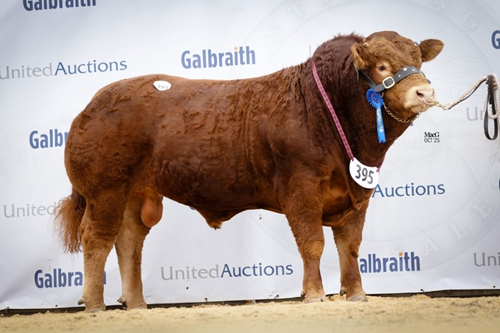
Recent bull sales have shown many purchasers are prepared to put significant investment into breeding bulls, which is justified when we see such high store cattle values. With a considerable investment, all measures should be taken to maximise the potential of the recent purchase, to ensure that he is correctly transitioned to his new home.
A newly purchased bull needs at least two to three months to adjust on farm and reach the right condition before going out with females. It is sometimes remarked that after a few days the purchased bull seems very restless and has temperament issues, this usually can be attributed to him having new surroundings and the need for time to settle in. At this stage, do not suddenly put him on a restricted diet as it is not good to have sudden changes in quantity and type of feed. It could be worthwhile to purchase or make up a good energy concentrate feed. Vendors can be approached and asked for a bag of the current bull feed to allow for a gradual transition.
Avoid sudden dietary changes at this stage. Abrupt restrictions or changes in feed type and quantity can cause unnecessary stress and may affect fertility. Feed him reasonably well initially to settle him and then slowly start to reduce the level of concentrates over a period of time. He is not used to just forage, so make sure that not only is the correct energy and protein fed but there are also the right levels of vitamins and minerals.
Most bulls have been group housed since weaning and are not accustomed to isolation. Do not simply purchase the bull and then put him in an area where he has little contact with what is going on roundabout him on the farm or in very confined dark pens. Yes, he needs to be quarantined (check what the rules are) but he needs to see actual movement going on round about such as people and livestock as he has had a lot of close contact prior to sale.
Be fully aware of the health status of your purchased bull. This includes BVD, Johnes and IBR. Clarify particularly whether IBR vaccination has been given. Discuss integration and vaccination plans with your local farm vet. You should also spend time with your investment. Allow him to have exercise, which he is used to when being reared. As soon as he is out of quarantine then close contact with other livestock is advised.
It is recommended that prior to the bull being used he is given a veterinary pre-breeding examination at least six to eight weeks prior to going out to females, to check the bull is physically fit and has adequate semen quality. The purchased bull should be tested when he is well settled and adjusted to his new home. Testing him close after purchase where so much change has occurred can affect semen test results.
Before he goes out to work, allow exercise in a small paddock with some company to prepare his locomotion and muscle tone for serving cows. Imagine Usain Bolt sat on his
behind for three months before running 100 metres - he would pull every muscle in his body! It’s a good idea to keep water and feed apart to encourage the bull to exercise.
Several commercial buyers now allow new bulls a pre-season trial with a couple of cows to see if he settles them, so they have confidence prior to the main bulling period. The young bull should be educated and serve his first female under supervision on a nonslip surface. Observe the bull closely at the start of mating to check for normal service behaviour and absence of any penile injury/lesions - e.g. warts.
A question which is often asked: how many cows should he go to when ready? Well, the view seems to vary from 10 to 20 females for a young bull. A useful guideline is one cow per month of age - for example, a 15-month-old bull to 15 females. The bull is untested, so it really is your choice. Monitor returns to service (more than 50% returns are suspicious). Although there can be pressure to maximise the use of an expensive purchase, a young, untested bull must be managed carefully. Many producers use a young bull for two cycles (around six weeks). After removal from the cows, he should be placed on a growing ration, as he still has significant growth and development ahead. Failure to do so can affect longevity and long-term performance.
Don’t get rid of the old boy (bull I mean) yet, as the young bull must prove himself and it is always worthwhile to have back-up on farm. Often, we lack bull power on farms and work with little, if any, back up. Finally, remember parasite control. Young bulls often have limited immunity, so worm and fluke dosing after the grazing period is important.
Gavin Hill, Senior Beef Specialist, Gavin.Hill@sac.co.uk
Posted by SAC Consulting on 17/02/2026
