

First Robotic Milking Machines Installed in Orkney
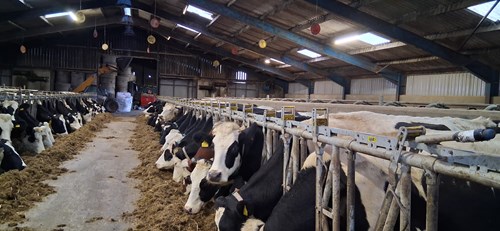
Finding good reliable labour is an increasing concern for our industry, leading many dairy farmers to look at the use of robots to improve efficiency and help with labour shortages. It is estimated that one in 10 UK herds now use robotic miking machines, with a surge in the number of businesses using the technology due to improved technology, the prospect of saving labour and the availability of grant funding.
The availability of grant funding through Highlands and Islands Enterprise (HIE), alongside Orkney Islands Council and Island Centre for Net Zero has provided an opportunity for dairy farmers on Orkney to move to milking by robot. This grant has successfully allowed one dairy based in Orkney to move from the traditional herringbone parlour to two robots and despite being in place for only three weeks the cows have increased in production by 15%. The hope is that other dairies within Orkney will also make the move towards robots to allow these herds to maximise production and ultimately keep the dairy industry within the isles moving forward.
Orkney Dairies
There are currently just 11 dairy farms in Orkney, this number has reduced from 23 dairies in 2007. In recent years through retirement and lack of succession the number of milk producers has dropped to a worrying level. Milk production on Orkney is important for several reasons namely that most of the milk produced is made into Orkney cheese. The original creamery was established in 1946 as a consequence of the milk supply having increased during the Second World War. If milk production were to fall the viability of this business alongside other food businesses, reliant on Orkney milk for bottling and ice cream making could potentially impact employment opportunities.
The grant has allowed a 45-year-old parlour to be replaced by two robots, fitted into an existing shed after some modifications. The two robots are capable of milking 110 cows maximum, and the area has been designed to allow the installation of a third robot should it ever be required. While robot milking systems can be efficient, the costs associated with installation are high and should be considered carefully as additional equipment is likely to be also be needed. Alongside the robots a new feed bin, Wi-Fi, foot bath, a new volume washer, slurry channel and a segregation area were also installed.
Building Design
Building layout is a key thing to consider when deciding on whether to go down the robotic route. A purpose-built shed is likely to be beyond the budget of many businesses, with most instead looking to incorporate robotic systems into old buildings. Some of the important things to consider include ease of handling cows for TB testing and AI and ensuring that there are no bottlenecks allowing cows to be frequently milked.
Cow Transition to Robotic Milking
Along with training staff, cows also need to be trained to the new system. After a period of intensive cow training and pushing cows into the robots, the Orkney cows have adjusted well. The first week was 24 hours a day to push cows into the robots, the second week this was reduced to 12-15 hours and in week three there are reports of being home in time for tea at 6pm! The cows are noticeably happier and calmer with the farmer noting that even the flightier cows that were prone to kicking in the old parlour are happy to be milked by the robot.
The installation of the robots has made a significant difference to the electricity costs of the business despite having two vacuum pumps and three water meters, the main difference would appear to be the efficiencies savings on the running of the bulk tank. Under the old system, the tank would run for five to six hours a day, now it is hardly on as the milk is cooled using water from a borehole, and it is fed using a trickle system.
Despite the recent drop in milk prices witnessed elsewhere, it is hoped that dairy farmers continue to invest in the use of technology to help to future proof their businesses. Long may Orkney continue to milk cows to make Orkney cheese.
Five Top Tips
- Grant funding is available through Highlands and Islands Enterprise (HIE). Consider eligibility and how your business could make use of the opportunities available.
- The simplest way to install robots is to have a purpose built shed, however, the cost can be prohibitive, it can be done retrospectively as in this case on Orkney. Planning is essential.
- While robotic milking systems can be an efficient, high-welfare option for dairy herds, costs are high and a decision to invest must be carefully considered against the suitability of your business.
- Although robots provide labour savings, labour is still required for herd management and maintaining foot health etc.
- Cows and farm staff will require training to the new system.
Useful Links
- www.fas.scot/article/mmn-march-2024-are-robots-for-me
- www.fas.scot/article/improving-carbon-efficiencies-at-hillend
Susan Pirie, Senior Consultant and Area Manager, Susan.Pirie@sac.co.uk
Posted by SAC Consulting on 11/12/2025
