

Feed and Forage Budgeting – Are you Prepared for Winter?
With many parts of Scotland experiencing a drought earlier this year resulting in lower yields creating a forage shortage, forage budgeting becomes critically important. By calculating supply and demand early, farmers can make informed decisions about how best to allocate limited feed resources, avoiding sudden shortfalls later in the season.
A clear forage budget helps identify deficits in advance, allowing time to adjust stocking rates, buy in extra feed, or change grazing plans before animal performance or welfare is compromised. It also supports more efficient use of what forage is available, minimising waste and ensuring priority stock receive adequate nutrition. Overall, good forage budgeting helps farms stay resilient, financially and operationally, during challenging years when grass growth and silage yields are well below normal.
The quality of silage will vary year to year depending on cutting/wilting time, grass quality and weather conditions. Analysing silage provides farmers and crofters with crucial information which can help improve both animal performance and profitability. By sampling silage, farmers and crofters can recognise if there is going to be a deficiency within their rations and make changes to their livestock’s diets appropriately. Knowing the quality of silage allows for better, more informed feed budgeting and helps to identify if rations are suitable for their stock. Ultimately, a high-quality silage will require less protein and energy to be supplemented from other feeds which can help keep housing costs lower over the winter period.
Below is a summary of silage quality from samples received by SAC Consulting up until the end of October this year split by pit/bales and cut.
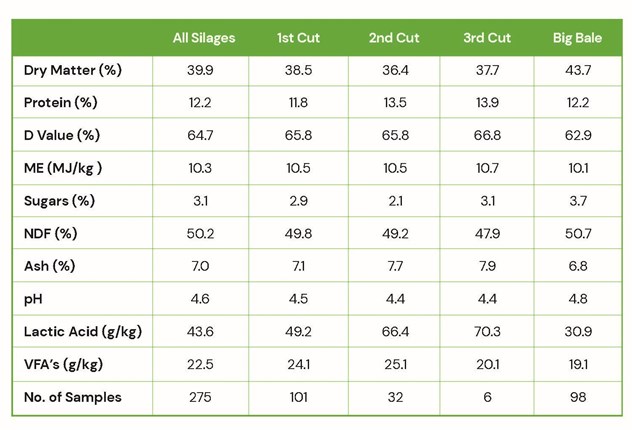
Silages made in 2025 are showing to be higher in dry matter (DM) than 2024, increasing from an average of 34.1% in 2024 to 39.9% in 2025 and appear to be consistently high across all cuts. However, there is a large variation in dry matter (DM) with the wettest silages around 18%, with several samples with a DM of more than 63%, which would be considered haylage. The wettest silages have typically been in the west and islands regions compared with the drier silages from the east of the country. SAC Consulting’s Ruminant Nutritionist Lorna Shaw, highlights that the lowest dry matter sample at 18% DM, means that one ton of fresh weight would only contain 180kg DM, the other 820kg being water. In comparison, silages at the highest end of dry matter at 60% DM would contain 600kg DM per one-ton fresh weight with only 400kg of water. This is more than double the DM of the wettest forage and mean that the dry silage would feed an additional 42 dry suckler cows per day (based on a 10kg/day dry matter intake).
It is important to remember that high dry matter silages are more susceptible to heating and spoilage, so clamp management is important, to minimise dry matter loss. Crude protein levels have increased on average from 2024, up from 11.5% to an average of 12.2% in 2025. Again, there has been a significant range in protein levels. Out of 275 grass silage samples submitted (up to the end of October 2025) 58% of samples have a protein of between 10-14% with 16% of samples less than 10% and 26% more than 14% crude protein on a dry matter basis. A dry ewe in mid-pregnancy will require around 12% CP on a dry matter basis just to meet maintenance requirements. The same for a finishing lamb. If taking a ewe to late pregnancy on forage alone, crude protein required would be at least a minimum of 14%. Therefore, of the silages analysed up to the end of October, only 26% of samples would be appropriate.
Metabolizable energy (ME) levels have dropped slightly when compared to ME levels in 2024 sitting at an average of 10.3 ME compared to around 10.6 ME at this time last year. Cattle energy requirements vary greatly depending on stock types and classification e.g. a dry cow requires a diet with a ME of around 9.0-9.5 MJ/kg DM, increasing to between 10-10.5 MJ/kg DM, when lactating. Higher ME silages should be targeted to feeding growing and lactating animals to help reduce reliance on concentrates, with lower ME silages fed to dry cows.
You can use the free FAS companion app to learn about how to assess forage supplies and complete a forage budget.
Useful Links
Hazel Laughton, Senior Consultant, Hazel.Laughton@sac.co.uk
Posted by SAC Consulting on 11/12/2025
