

Report highlights role of automated acoustic tools in monitoring of farmland wading birds
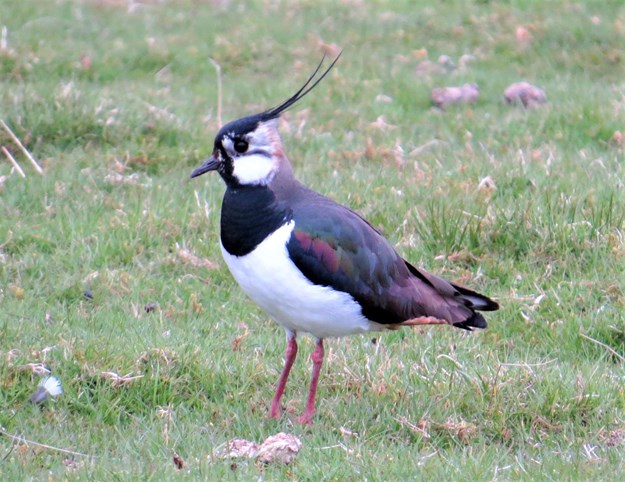
Wading birds on farmland are in serious decline, with the UK losing more than half of its breeding Curlews, Lapwings and Redshanks since 1994. As efforts increase to better understand their status and habitat use, a new report highlights how automated acoustic classifiers, alongside traditional survey methods could transform the monitoring of these species.
Tools such as BirdNet use machine learning trained on libraries of manually identified bird calls to help detect and identify more efficiently across large areas.
Agri-environment schemes incentivise conservation on farmland by providing payments to support wildlife-friendly management. However, their effectiveness has typically relied on infrequent, large-scale surveys which do not produce suitable evidence to adapt schemes at a local level.
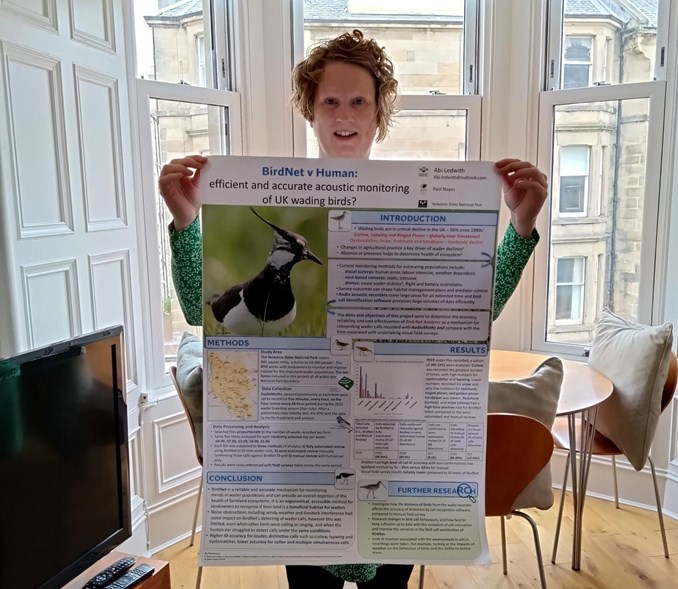
A new report from the British Trust for Ornithology (BTO), with collaborative input from SRUC MSc student Abi Ledwith, showcases an innovative project combining data collection by farmers with use of audio recorders and AI processing to aid monitoring these species.
The project took place in the Yorkshire Dales National Park, where farmers deployed acoustic recording devices across their land. Alongside this, skilled carried out traditional bird surveys, and farmers recorded the weekly presence of wading birds. In total, 1,440 hours of audio recordings were collected.
These recordings were analysed using BirdNET Analyzer, a tool that is trained by machine-learning to detect and classify calls and songs made by birds. As part of her dissertation for SRUC’s Wildlife and Conservation Management MSc, Abi assessed how accurate BirdNET Analyzer was at detecting and correctly identifying calls from five species of wading birds. She listened through over 300 five-minute recordings, identifying over 2,200 distinct wader calls.
For Curlew, Lapwing, Oystercatcher and Snipe, the automated identification software achieved over 90% precision (meaning that more than 90% of the detections made by BirdNET were correct) and recall (meaning that more than 90% of calls detected by humans were also correctly classified by BirdNET). In contrast, while Redshank calls were almost always detected (with a recall of 97%), BirdNET’s precision was lower for this species, with nearly half of the classifications being false positives.
The study found that data from automated acoustic recorders showed similar patterns of species activity to reports from farmers and to formal surveys. This demonstrates strong potential for using these approaches on their own or in combination to provide timely and reliable data on presence, relative abundance and activity of farmland breeding waders.
Abi said: “By combining AI tools like BirdNET with farmer observations and traditional surveys, we can build a much clearer, more responsive picture of how wading birds are using farmland. This approach has real potential to support more adaptive and cost-effective agri-environment schemes.”
Abi completed the research while studying on SRUC’s part-time distance-learning MSc in Wildlife and Conservation Management. She undertook the project in collaboration with the BTO as part of her dissertation.
Now working as a ranger with Yorkshire Water, Abi previously transitioned into ecology from a career in higher education, highlighting the accessibility of the programme for career changers.
Paul Noyes, Wader Ecologist, British Trust for Ornithology said: “It was a pleasure to work with Abi and SRUC on this project. It was a real partnership effort, with every farmer, national park staff member, volunteer, and scientist involved playing a critical role. This project's results also suggest passive acoustic monitoring has potential to provide inferences on wader breeding success; this could be a real game-changer for monitoring agri-environmental scheme outcomes but needs further research to explore this potential".
Applications are now open for the MSc Wildlife and Conservation Management programme starting in September 2026. Visit the website for details.
Posted by SRUC on 22/05/2026
