

Another successful year for the endangered corncrakes
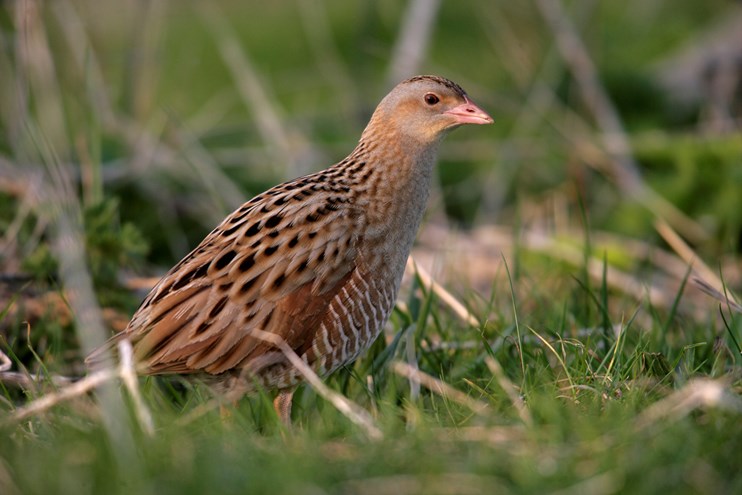
One of the most distinctive sounds on Skye was heard across the island again this summer thanks largely to the continued efforts of crofters.
Numbers of the corncrake – known for its familiar ‘crex, crex’ call, which can be made up to six million times by a single male in the breeding season – had previously plummeted to single figures on the island.
However, the Skye Crofting and Corncrake Partnership - supported by SAC Consulting (part of SRUC) - has found new ways of encouraging the elusive brown birds, including changing how land is managed.
The latest RSPB figures for summer 2026 estimate there were 26 calling males on Skye. Although that is slightly down on the 28 recorded in 2025, this year’s figure is widely expected to be an underestimate and is another sign that the partnership’s work is reaping dividends.
Skye is one of only a handful of islands where corncrakes can still be found in Scotland, alongside just one remaining mainland site on the north coast.
Janette Sutherland, Senior Consultant with SAC Consulting on Skye and a crofter herself, said: “These figures are a testament to the efforts the crofters have made in what has been a tough year for them.
“While it may have been particularly warm and dry across a lot of the UK, it was a wet summer on Skye, which meant crofters often had to mow when they could. The continued success of this partnership underlines the efforts they are going to in supporting the species.”
Corncrakes are a shy species and rely on tall vegetation cover to breed successfully. Accordingly, crofters are encouraged to delay their mowing of silage and hay until August, when the first broods will have safely fledged.
They are also encouraged to use wildlife-friendly mowing practices, including cutting out from the middle and therefore allowing the corncrakes to reach the edges of fields without breaking the cover of the uncut longer vegetation.
Shelagh Parlane, Corncrake Project Officer at the Royal Society for the Protection of Birds (RSPB), said: “We are really pleased – these latest figures show that we can support and build a corncrake population here on Skye.
“At one point, numbers had fallen so sharply that we feared they would vanish from Skye, and from their other remaining strongholds in Scotland, within five years. Beyond the occasional remote island, it seemed they might disappear from Scotland altogether.
“We are really grateful to everyone who has contributed to such a successful initiative and, in particular, those who manage the land where we know corncrakes are present.”
The RSPB helps monitor numbers by listening for the sound of calling males overnight. Some areas of Skye have proved to be particular hotspots for the shy visitor, with Shelagh adding: “I heard six of them in one place, all calling synchronously, which was quite special.”
The Skye Crofting and Corncrake Partnership includes SAC Consulting, the RSPB, NFU Scotland, the Scottish Crofting Federation, crofters, farmers, conservationists and the local community.
The Corncrake Initiative started as part of the Corncrake Calling project from 2020 to 2024, led by RSPB Scotland and supported by The National Lottery Heritage Fund. The funding allowed the scheme to pay crofters and farmers to delay mowing, which has been continued by the RSPB in 2025 and 2026.
The females and second brood chicks leave the island in late September to make an epic and indirect 6,000-mile trip to the Democratic Republic of Congo for winter – a journey that can take them up to two months to complete.
Those that survive their travels tend to return to Skye and other Scottish sites in April, finding refuge in rougher vegetation along sheltered ditches and walls until meadow grasses begin to grow.
Their maximum lifespan is only three years, so a successful breeding season is crucial for the long-term survival of the species.
Skye crofters and farmers who adapt their working practices to help benefit the environment can be supported via the Corncrakes Initiative and the Scottish Government’s Agri Environment Climate Scheme (AECS). The latter provides funding for management and capital ideas that benefits Scotland’s environment, with the 2027 application round set to open early in the new year.
For more information on the support available through SAC Consulting, including advice on AECS applications, visit www.sac.co.uk.
Posted by SAC Consulting on 06/10/2026
