

Treating Cold Lambs with an Intra-Peritoneal (IP) Injection
The ideal scenario at lambing is a healthy ewe with plenty colostrum and milk giving birth, unassisted, to a healthy lamb of adequate size. Get this right and the lamb will have enough energy reserves to maintain normal body temperature for around five hours. However, once the lamb has exhausted these reserves, if no other energy source is available, hypothermia will quickly occur, resulting in the lamb’s death.
An intra-peritoneal (IP) injection of glucose or dextrose solution gives a lamb the energy boost they need to survive when they have used up their own supplies. Although it looks alarming, it is a simple procedure, which can prevent lamb deaths.
Lamb development and brown fat
During the last six weeks of pregnancy, brown fat is laid down around the lamb's heart and kidneys. This brown fat is the only energy source of the newly born lamb and will keep the lamb alive and vigorous for approximately five hours after birth. Normally this will allow enough time for the lamb to get dried off and start to suck. Once sucking properly, the ewe’s colostrum takes over as the main source of energy. If the lamb is born in wet, cold and windy conditions, this brown fat will be used up more quickly. Unless the lamb feeds, or receives another source of energy, it will become hypothermic.
How to treat hypothermia
When treating hypothermia, the first thing to do is check the lamb's temperature with a thermometer:
- 39-40C (102-104F) is normal
- 37-39C (99-102F) is mildly hypothermic
- Below 37C (≤99F) is severely hypothermic
Treatment for hypothermia depends on the temperature and age of the lamb.
When to give the IP injection?
- If the lamb is cold, flat, drowsy and weak
- If the lamb cannot hold its head up or suck
- If the lamb is over five hours old
Administering the IP injection
You will need:
- 50ml syringe
- Freshly boiled water
- 1-inch sterile needle
- 40% dextrose/glucose solution
If glucose solution is unavailable, you can make your own solution with glucose or dextrose which can be bought from chemist shops. Dissolve 20g of glucose/dextrose powder in 25ml hot boiled water, then make up to 50ml with boiled water.
- Allow to cool.
- Draw 25ml of 40% glucose solution into a syringe.
- Draw up a further 25ml of freshly boiled water (this results in the perfect temperature).
- Attach a new 1-inch sterile needle.
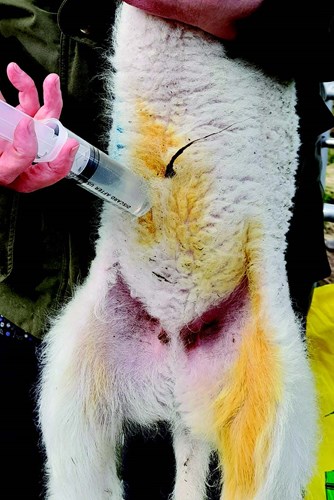
- Holding the lamb upright by its forelimbs, insert the needle into the abdomen at a 45° angle towards the tail to the side of the navel. It doesn’t matter which side of the navel.
- Push the needle fully in (if blood or urine appears withdraw immediately). If there is resistance to injecting the fluid the needle should be re-positioned.
- Slowly inject the full 50ml.
After the injection
After the IP injection, the lamb can be warmed up either in a warming box or under heat. Recheck the lamb’s temperature after half an hour to ensure that it isn’t overheating. The lamb should stand within 30 – 60 minutes. Once the lamb has reached normal temperature and is alert, it can be given colostrum by stomach tube and returned to the ewe.
For more information on IP injection, Scotland’s Farm Advisory Service (FAS) website has a handy online Hypothermia Decision Tool, to help with decision making as to which treatment is best. The decision tool can be found here.
It works on a mobile, so save the link to your phone for use in the field or shed.
5 top tips
- Invest in a digital thermometer. These are inexpensive and can be used to help guide decision-making.
- Before administering any treatment always check the lamb’s temperature. The normal temperature for a lamb is 39°C.
- If the lamb is between 37°C and 39°C and able to swallow, it should be fed warm colostrum by stomach tube and warmed under a heat lamp in a draught free pen with the ewe.
- If the lamb is below 37°C and able to swallow then it should be warmed, using a heat box to 37°C before being fed and returned to its mother.
- If the lamb is below 37°C, unable to swallow and over five hours old, then give an IP injection. Never stomach tube before an IP glucose injection – milk could kill the lamb.
Siobhan Macdonald, Senior Consultant, Siobhan.Macdonald@sac.co.uk
Posted by SAC Consulting on 13/03/2026
