

Slurry Storage and Spreading
Slurry Storage and Spreading
January 2027 marks the final phase of the Diffuse Pollution General Binding Rules (GBRs) updates, with practical implications for livestock farmers on slurry-based systems.
Changes to the rules around how we manage and store silage and slurry were introduced on 1 January 2022. These amendments aimed to improve nutrient use efficiency on farm while reducing environmental impact.
The regulatory updates were phased over five years, with target dates specifying when each change applied. For example, early changes from January 2023 prohibited the use of raised splash plates or rain guns for slurry application. The amended regulations also required the use of low emission slurry spreading (LESS) techniques, initially focusing on contractors and farms with larger herd sizes of over 100 milking cows or 200 beef cattle.
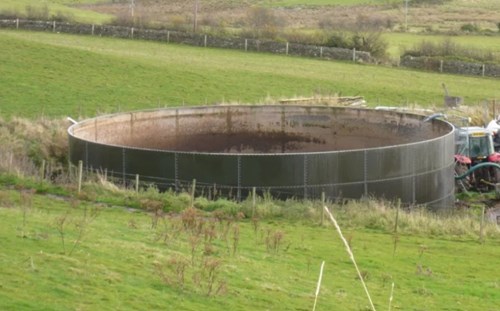
Most recently, changes have been introduced around minimum storage capacity for those on a slurry-based system. With effect from 1 January 2026, farms should have a minimum of 22 weeks slurry storage (applicable to cattle; 26 weeks for pigs) bringing all farms into line with the Nitrate Vulnerable Zone (NVZ) storage requirements. This represents a reduction from the previous requirement of 26 weeks and gives a single minimum storage requirement for all farms across Scotland.
With the requirement for 22 weeks slurry storage, some may need to reassess current arrangements and increase or replace slurry storage facilities. For others, it could be a case of making better use of the storage already available on the farm. By reducing the amount of clean water on dirty yards getting into the slurry collection system or diverting lightly contaminated water to a constructed farm wetland, you could free-up more space for slurry storage.
Subject to eligibility conditions, funding is available under the current Agri-Environment Climate Scheme (AECS) for various rural SuDS (Sustainable Drainage Systems) including a constructed farm wetland. The scheme is open until 22 June 2026. Slurry separation may also be a practical option to consider for some.
From 1 January 2027, all farms must adopt precision slurry application techniques. Acceptable methods include dribble bars, band spreaders, trailing hoses, trailing shoes, or direct injection. Use of splash plates will be prohibited.
There are practical resources to help manage dirty water and slurry volumes. A steading checklist and guidance on calculating slurry from housed livestock can be found on Farming and Water Scotland. Additional GBR guidance, FAQs, and pollution reduction measures are available here.
Useful links
Rebecca Audsley, Principal Consultant, Rebecca.Audsley@sac.co.uk
Posted by SAC Consulting on 11/03/2026
