

Seaweed – The Free Fertiliser
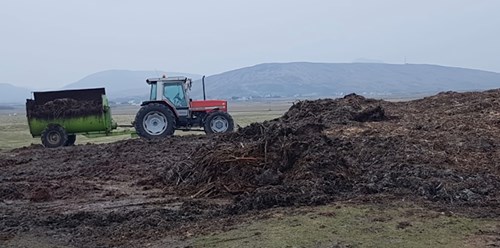
Seaweed has been used as a fertiliser for grass and crop production for many years and provides coastal crofters with a valuable source of nutrients that can be used to supplement bagged fertiliser. It contains nutrients, organic matter, and trace elements that make it a very useful fertiliser for those fortunate enough to have a source available nearby.
Like all organic manures, seaweed has a variability in nutrient content. Therefore, to get the most benefit from seaweed as a fertiliser, it is advisable to take a representative sample to have analysed prior to application. Analysis carried out by SAC Consulting found typical nutrient values for fresh seaweed as shown in the table below.

Unlike bagged fertiliser, not all these nutrients are available from seaweed in the year of application, and it is important to bear this in mind when planning applications.
Approximately 5-15% of the Nitrogen (N) will be available, 50% of the Phosphate (P), and 80% of the Potash (K). Nitrogen is available as organic N (where the nitrogen is contained in organic forms that break down slowly to become potentially available for crop and grass uptake over a period of months or years) or as readily available N (available for rapid crop uptake).
In comparison, Farmyard Manures (FYM), seaweed contains slightly higher levels of readily available nitrogen which can be lost easily if applied at the wrong time of year when there is not a crop need.
Approximately 50% of the phosphate in seaweed is available to the crop in the year of application with the remainder becoming available to the crop in following years. Seaweed is a useful source of potash and approximately 80% is available to the crop in the year of application with the remainder adding to the soil reserves. Seaweed also contains an appreciable amount of sulphur and magnesium and amounts of the micronutrient’s boron, cobalt, copper, iodine, manganese, selenium and zinc which can be beneficial to both crops and livestock. So that nutrients can be fully utilised, it is essential that the soil is at the correct pH of between 5.8 and 6.0 for grassland. Also, fertiliser requirements will depend on whether the grass is for grazing livestock or cutting for silage. Relatively little will be required for extensive grazing, whilst intensive silage production results in a lot of nutrient offtake, which needs to be replaced.
Seaweed directly adds the nutrients detailed above, but they have also been shown (particularly in the horticultural sector) to act as plant bio stimulants. Containing hormones that trigger increased growth and improve nutrient uptake in plants and seaweed can also impact various elements of the plant’s successful growth.
The addition of seaweed can also have beneficial impacts to soil structure, water retention, and nutrient holding capacity. This is due to the organic matter being added to the soil, and to the presence of alginates in the seaweed, which have structural influences on soils.
A recent study has found that potassium deficiency in agricultural soils has the potential to be a major threat to future agricultural production. Volatility in the price of potash, plus more general question marks over the sustainability of mining has led to potash being underapplied to agricultural land. Seaweed has the potential to fill this gap, for those with ready access, as a sustainable source of the nutrient that does not suffer price volatility, or a high carbon footprint.
5 top tips
- Like all organic manures, the nutrient content of seaweed is variable. Analysis prior to application is advised.
- Not all nutrients are immediately available to the crop, but they do help to build soil reserves. Remember to account for this in your fertiliser use.
- Assuming application is carried out at the optimum time of year, seaweed is a very useful source of potash, so it can be a great help to potash hungry crops such as grass silage.
- Seaweed contains other nutrients such as sulphur, magnesium and varying amounts of various micronutrients, which can be beneficial to crops and livestock.
- Seaweed should be allowed to breakdown fully before grazing or cutting.
Useful links
- www.fas.scot/downloads/cropping-case-study-use-of-seaweed-as-a-fertiliser-for-grassland
- www.fas.scot/publication/technical-note-tn714-liming-materials-and-recommendations
David MacKay, Consultant, David.Mackay@sac.co.uk
Posted by SAC Consulting on 11/03/2026
