

SRUC partners in UK research to cut dairy methane emissions
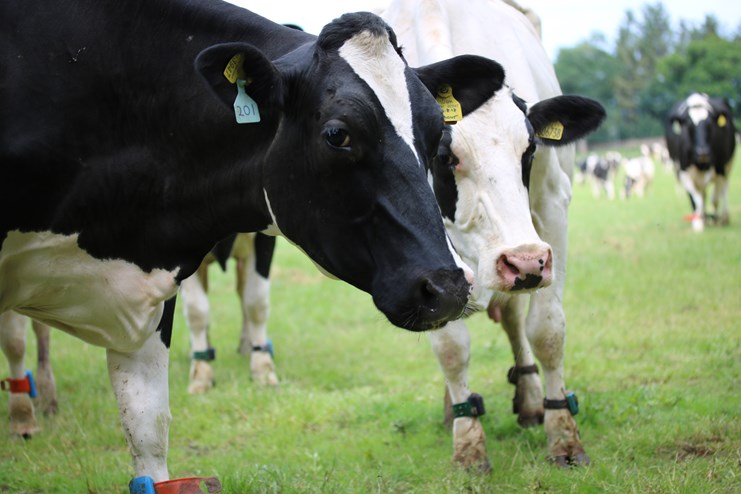
SRUC is playing a leading research role in a new UK-wide project aiming to significantly cut greenhouse gas emissions from dairy farming while reducing reliance on imported soya bean meal.
The InFaba project, funded by Defra’s Farming Innovation Programme and delivered in partnership with Innovate UK through the Farming Futures R&D Fund: Low Emission Farming Competition, brings together crop science, ruminant research experiments and on farm trials, underpinned by an environmental life cycle assessment and economic analysis.
Led by McArthur BDC, the consortium aims to support a reduction in dairy sector emissions by more than 1.5 million tonnes of CO₂ equivalent annually, with a value approaching £400 million, by cutting methane emissions and soya bean meal with innovative homegrown faba bean-based feed ingredients.
The three-year, £1.9 million programme brings together SRUC, McArthur BDC, the Processors and Growers Research Organisation (PGRO), Muller UK & Ireland and the Farm Carbon Toolkit. The work is underpinned by a full environmental life cycle assessment and economic analysis to ensure the solutions are robust, measurable and commercially viable.
Methane accounts for around 58% of British agriculture’s greenhouse gas emissions and 45% of emissions from the dairy sector. Previous exploratory work undertaken by SRUC showed that the naturally occurring tannins in a faba bean co-product may alter the fermentation process and reduce methane formation, but little research exists in this area.
SRUC Professor of Dairy Nutrition, John Newbold said: “Our role within InFaba is to combine laboratory studies with on-farm trials to measure reactions in methane output and improvements in how efficiently cows convert feed into milk.”
The project will develop and test two novel faba bean-based feed ingredients for dairy cows:
- A tannin-rich faba bean co-product from the feed sector will be assessed for its ability to influence rumen fermentation and reduce methane production.
- A heat-treated faba bean, processed to deliver more digestible protein and replace a significant proportion of imported soya bean meal in dairy diets.
UK dairy farming also consumes 15% of the UK’s imported soya bean meal; its excellent nutritive properties are offset by a high embedded carbon footprint and links to deforestation and land-use change in South America.
Increased inclusion of faba beans in arable rotations can also improve soil health, enhance biodiversity, improve water quality and strengthen the resilience of UK food and feed supply chains.
John McArthur, Project Director and Managing Director of McArthur BDC, said: “Methane from dairy cows is a major contributor to agricultural emissions. The InFaba Project will explore whether naturally occurring tannins in UK-grown faba beans could offer a home-grown route to lowering emissions in dairy herds.”
From a supply-chain perspective, Muller UK & Ireland will support on-farm testing and evaluation. Phil Scott, Retail Group Manager, said: “We have ambitious targets for scope 3 emissions reduction and opportunities like this could be a big step in the right direction. Working with our farms gives us a direct route to test and scale this innovation, based on a 100% natural plant-based product, with the potential to cut emissions without compromising milk quality.”
By integrating emissions data into milk supply chains, the project also aims to enable farmers to be recognised and rewarded for verified emissions reductions.
Posted by SRUC on 02/02/2026
