

Crop updates: February 2026
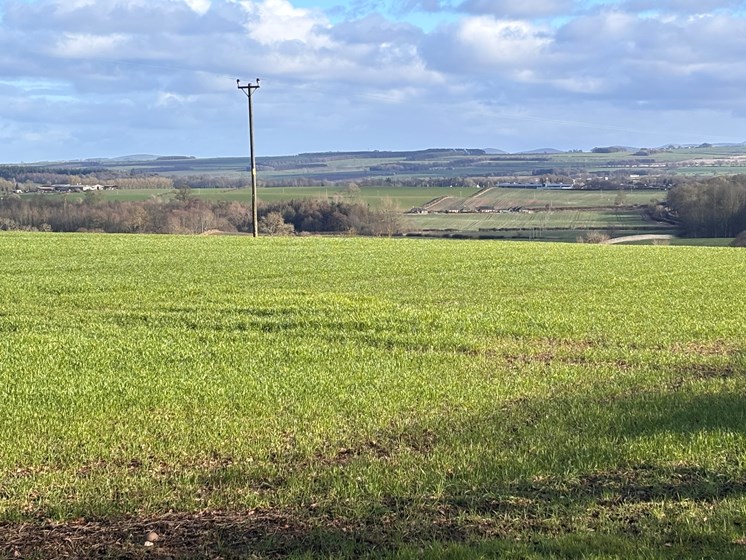
Our regular round up of the issues affecting crops around Scotland, summarises how crops are developing and what weather and other issues are affecting them. The update provides information on the progress with key field work activities as well as news on the pest, weed and disease problems being noted in crops. The health issues being seen in crops are a key part of the topical update and lets growers and agronomists adjust management practices appropriately.
13 February 2026
General Comments
Good autumn establishment, rooting and tillering have kept crops in good fettle through what has been an exceptionally wet start to 2026. Progressing early ploughing and other field work, has, on the other hand, been frustratingly delayed by waterlogged soils. Variable disease levels are reported regionally although notably septoria appears more evident in wheats compared to last year. Fodder stocks are given as less plentiful due in part to the dry summer of 2025 and the need to increase feeding levels over the winter.
Regional Comments
CAITHNESS
The much-anticipated snow thaw in early January was unfortunately replaced by rain every day since. Ground is very wet in the area with no land work being undertaken. Winter crop has certainly gone back in the last couple of weeks with the prolonged rain. Fodder stocks have also taken a bit of a battering with increased intake by sheep over the past month; supplies are definitely tight. Straw still seems to be plentiful.
MORAY
As cereal markets remain depressed, the only certainty at the moment is rain. It's hard to recall a dry day, well this year even. Some farmers are quickly having to adjust cropping plans as many malting barley contract tonnages have recently been halved or worse. Some have turned to winter wheat with large acreages sown last week whilst others are planning grass instead. Winter crops are looking ok if not a little of colour and winter barley in particular having lots of yellow leaves. If the weather improves to coincide with the lifting of NVZ restrictions (20 February here) then some nutrition can be applied.
INVERNESS
Over the past fortnight, weather conditions around Inverness have been unsettled and variable. There has been a mix of cloud, rain, showers, and occasional light snow, with some breezy periods. Daytime temperatures have reached around 8–10 C, while night-time temperatures have fallen below freezing on some nights, giving an average temperature of around 3–4 C. Winter crops are well established and in good condition. Both the winter barley and winter wheat appear healthy and continue to develop well. The winter wheat at Lower Kincraig has seen a thickening of the crop which is noticeable even on the way to the field. The winter oilseed rape is progressing from leaf development into side-shoot formation. A small amount of weed growth is present in the oilseed rape, but no weeds have been observed in the barley or wheat. Conditions are expected to remain cool, with further cloud and occasional showers. This should support steady, ongoing crop development in the coming period.
BANFF & BUCHAN
The January snows are now a distant memory with the Aberdeenshire weather now becoming a source of many unwanted statistics. With rain almost every day, water tables are very high, and fields saturated with many now having water lying in lower areas. Burns and rivers are also very high and bursting their banks in places. Adding to the gloom is the fact that sun has not been seen for a number of weeks! Arable farmers are having to cool their heels with very little land work undertaken for a couple of months. Ploughing has fallen well behind in many cases and remedial works such as drainage have become impossible. In a weeks’ time the NVZ exclusion period for fertiliser will be over, although ground conditions dictate that farmers will need to be patient before they start top dressing winter crops. Despite the continually wet soils, winter crops are on the whole looking well although there is some yellowing in winter barleys. With the days noticeably stretching, a much-needed spell of warm and dry weather is hopefully not too far away although soil nitrogen levels may be lower than normal.
ANGUS
We have yet to see a dry day in 2026 with many areas having seen over a foot of rainfall year to date. Winter crops however mainly look good so long as they have not been under water. Winter ploughing has not really got underway and there will be a lot of work to get through in a short space of time once things dry up.
PERTHSHIRE
Persistent rain has meant that ground conditions are wet and it is a struggle to even get cattle courts emptied into fields let alone spread manures. Crops went into the winter strong and are fairing well but there is disease building in most crops but little prospect of being able to do anything about it in the near future. Frosts have killed off volunteer cereals and cover crops which were quite proud in the autumn.
FIFE
Due to the very wet weather crops have stood still since last report. Some areas of winter barley and wheat are submerged due to lack of drainage activity. Disease levels are average for the time of year with mildew and some low-level net blotch to be found in winter barley. Septoria can be found in forward wheats, but no yellow rust found yet. Winter ploughing has now fallen behind where farmers normally hope to be at this time of year, a return of drying winds and frost would be welcomed.
STIRLINGSHIRE
The Winter crops in Stirling have held up well despite almost continuous wet weather. Overall crop condition is good, though some carse fields remain flooded. Notably, fields managed without ploughing and drilled with one‑pass Sumo systems on the heavy soils are showing better water infiltration with water clearing faster. Ground conditions are currently untravellable, but many growers hoping to apply P & K to winter crops within the next two weeks if ground conditions improve and where their soils show a requirement. Disease levels remain low in both WOSR and cereals. Recent cold weather has helped keep the small amount of disease present largely static. Larger OSR canopies were expected to attract more pigeon damage, but this hasn’t materialised likely helped by the wider use of cover crops. Slug activity is present, but visible damage is minimal. Weed pressure is present but largely under control thanks to effective autumn herbicide applications. Outwintered stock are causing some poaching due to the prolonged wet spell but that’s to be expected given the start to the year we have had. Significant reductions in spring barley area planned for 2026.
LOTHIANS
Continuing rains are a frustration for many coming on top of the 60-80mm received through January. Crops, on the whole, look well, although remain stationary at their overwinter growth stages and while waterlogging isn’t widespread, a lot of land is nearing field capacity. Disease levels vary in winter cereals, some barley is showing considerable necrosis of older leaves as well as the presence of rynchosporium lesions. Septoria spp is already evident in wheats and is likely to lead on to a higher-pressure season than we’ve seen for a few years. Potentially soil nitrogen supplies will be diminished this spring given the volume of rain so far and a dry period over the coming weeks, if it arrives, will do much to help facilitate timely fertiliser applications once we move into March.
BORDERS
The dreich weather of January has continued into February with rainfall continuing to be above average. Unusually, the eastern Borders is wetter than the west with SEPA data recording 138mm near Coldstream and 96mm near Galashiels. If the weather pattern continues winter rainfall will exceed 450mm and growers in NVZ areas will have the option to apply additional nitrogen to crops form residue groups 2 - 6. Ground conditions are soft and it will take a run of dry days with a breeze before growers can contemplate any early fertiliser applications.
That said, well-established autumn crops are well tillered and have good colour albeit with higher disease levels. Oilseed rape is carrying more yellowed lower leaves and will be the priority crop for nitrogen. Time will tell if that is February or early March.
AYRSHIRE
Like most of Scotland, the last fortnight has been a wet one, with little opportunity to get on the ground and get much done. Winter sown barley is tillering away in the fields, with the crops observed being between growth stage 21 – 25. Some of the winter barley looks a little battered in the weather, but signs of disease or deficiencies are few and far between. Dung has been spread where possible and farmers have suggested that they will get ploughing in the next fortnight weather permitting. The local consulting office is seeing more forward planning of greening this year, as farmers try to grapple with new the requirements, with an even mix of new and returning farms having to implement or review Ecological Focus Areas.
LANARKSHIRE
The winter crops in the area are doing relatively well, we have experienced a much kinder winter than our neighbours to the north, with less snow and persistent heavy rain. We do have some fields with bare spots due to wet weather in the autumn and the wetter weather is creeping in now with the odd waterlogged field, slowing growth. Temperatures have been fluctuating from -4°C up to 10°C in the past fortnight, with the forecast remaining mostly unchanged for the rest of the month. Ground conditions have allowed for sporadic spreading of FYM and slurry in recent weeks, with the ground currently wet underfoot. A number of farms are looking forwards to their spring cropping plans, and many are now incorporating new measures to comply with their EFA requirements.
DUMFRIES & GALLOWAY
Crops have come through the winter in good shape and are generally stronger than usual, with disease levels remaining low. Ground conditions have also been favourable, allowing muck spreading and ploughing to be completed in good time, and many growers have taken the opportunity to apply lime where needed. Attention will now begin to shift towards nitrogen applications and deciding on appropriate rates.
Posted by SRUC on 17/02/2026
